

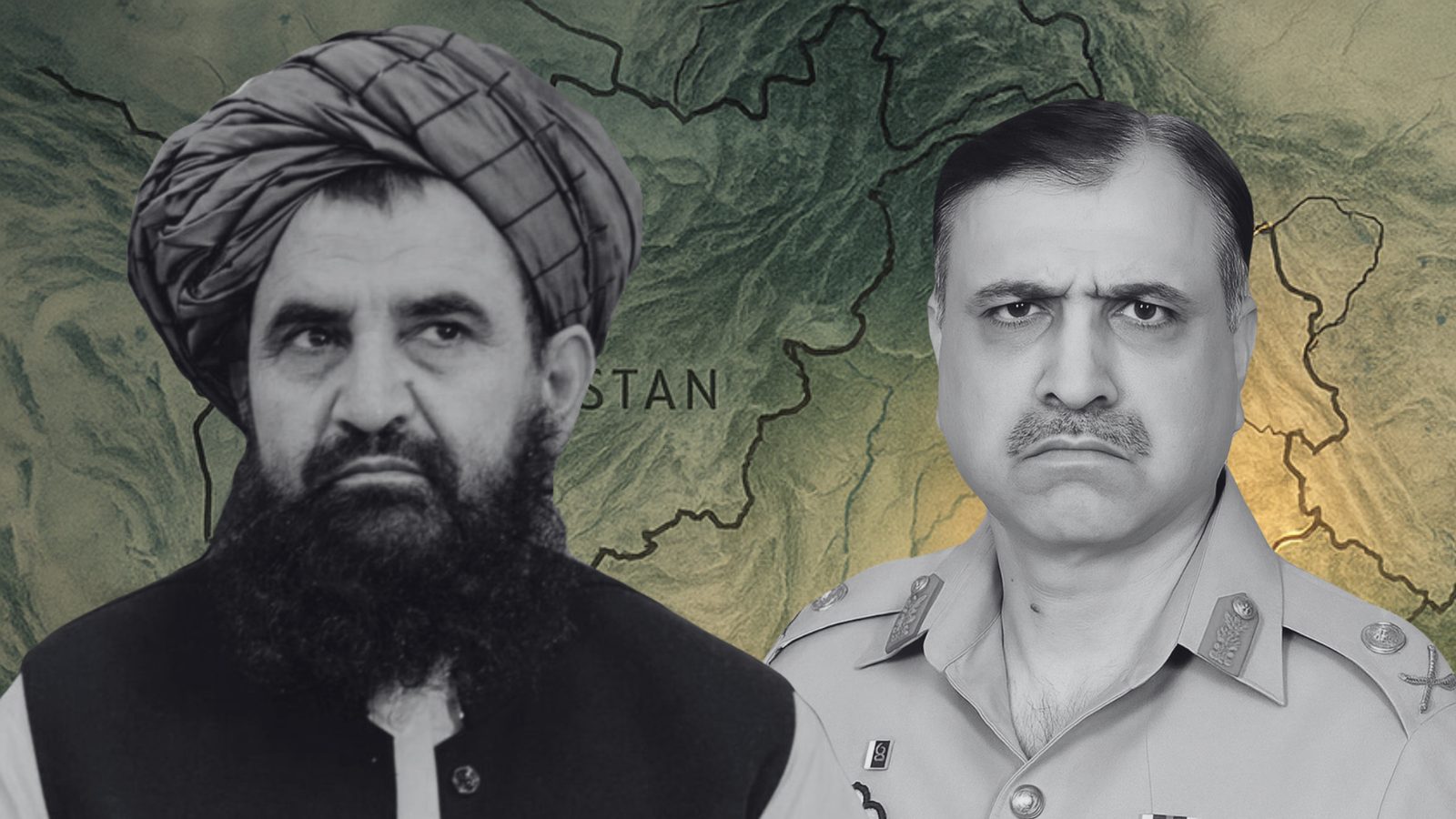
Leaked details from the latest Afghanistan–Pakistan negotiations in Istanbul reveal that the high-level talks, led by the intelligence chiefs of both countries, have reached a deadlock. Afghan officials accused Pakistan of ‘weaponising’ refugee expulsions and trade crossings to destabilise Afghanistan and facilitate the infiltration of Islamic State Khorasan Province (ISKP) operatives.
Intelligence Chiefs Lead Third Round of Talks in Istanbul
According to diplomatic and security sources familiar with the matter, the Pakistani delegation was led by Lieutenant General Asim Malik, Director General of the Inter-Services Intelligence (ISI), while the Afghan side was represented by Mawlawi Abdulhaq Wasiq, head of the General Directorate of Intelligence (GDI).
This was the third round of negotiations between Kabul and Islamabad, held behind closed doors in Istanbul, Turkey, and co-facilitated by Qatar and Turkey. The presence of both countries’ intelligence heads underscored the centrality of security concerns to the dialogue, but it also reflected the deep mistrust that continues to define the relationship.
Despite high expectations, sources say the talks quickly broke down because Pakistan refused to broaden the agenda and both sides accused each other of bad faith.
Kabul Accuses Pakistan of Using Refugees as a Weapon
Leaked reports of the meeting indicate that the Afghan delegation focussed principally on Pakistan’s ongoing mass expulsion of Afghan refugees, which were termed a ‘calculated act of political coercion.’ Kabul’s negotiators alleged that the deportations were not only humanitarian violations but also a means of facilitating ISKP infiltration into Afghanistan. According to one source, the Afghan side told its counterparts that militants affiliated with ISKP were slipping across the Durand Line disguised as deported refugees, using Pakistan’s chaotic deportation process as cover. The Afghan delegation reportedly presented intelligence suggesting that infiltration routes had been detected by Afghan security services.
A source in Istanbul overheard one of the Afghan negotiators saying:
‘Pakistan is not simply deporting our people. It is weaponising the process to send in ISKP cells. They are trying to turn a humanitarian tragedy into a security threat for Afghanistan.’
This accusation has been further reinforced by public statements from Pakistan’s own leadership. In 2024, the caretaker Prime Minister, Anwaar ul Haq Kakar, admitted in an interview with TOLOnews that the ongoing expulsion of Afghan refugees is being used by Pakistani authorities as a form of pressure on Kabul to act against the Tehrik-i-Taliban Pakistan (TTP). Afghan officials cited this admission as clear evidence that Islamabad views the refugee issue not as a humanitarian matter, but as a political instrument to extract concessions.
Kabul demanded that Islamabad immediately halt the expulsions and coordinate future returns through a joint verification mechanism to prevent infiltration. Afghan negotiators said the current deportation campaign was destabilising Afghanistan’s fragile economy and threatening its security.
‘A Form of Economic Warfare’
The Afghan side also accused Pakistan of using trade routes as leverage, citing frequent closures of the teeming crossings at Torkham and Spin Boldak as deliberate economic pressure tactics.
Afghan representatives described such actions as ‘a form of economic warfare,’ that crippled Afghanistan’s imports and exports, raised prices, and undermined public confidence in an already precarious economy. They highlighted the humanitarian dimension as well, noting that many Afghans requiring medical care in Pakistan were trapped by sudden closures at crossings on the Durand Line and frequently mistreated.
‘Each time Pakistan wants to exert pressure, it shuts the [crossings]’ said an Afghan delegate, according to the leaks. ‘They know Afghanistan is landlocked. It is an intentional act to weaken us.’
The Afghan delegation urged the Pakistani side to establish an agreement guaranteeing the uninterrupted operation of trade crossings, arguing that politicising economic routes ‘benefits neither side,’ amidst the heavy losses incurred by traders.
Kabul Raises Drone Flights, ISKP Networks, and Opposition Support
The Afghan delegation also raised several other concerns that have long strained relations between the two countries.
Foremost among these was the issue of US drone reconnaissance flights above Afghanistan, which Afghan officials have long alleged use Pakistan’s airspace and condemned as a ‘violation of national sovereignty.’ Pakistan’s continued cooperation with American drone operations, Kabul underscored, undermined regional stability and directly infringed upon Afghanistan’s airspace. The negotiations once again featured the Afghan delegation demanding Islamabad to halt all such activities, warning that these flights had become a persistent source of tension and mistrust.
The Afghan side further drew attention to what it described as the presence of Islamic State Khorasan Province (ISKP) networks inside Pakistan, particularly in the provinces of Balochistan and Khyber Pakhtunkhwa. Afghan representatives said these groups posed a serious threat not only to Afghanistan’s internal security but also to neighbouring states, including Iran, Russia, and the Central Asian republics. Kabul maintained that Pakistan’s inaction against ISKP elements was contributing to the region’s instability and demanded ‘credible and transparent’ counter-terrorism measures. The presence of ISKP in Balochistan is further corroborated by the terrorist groups own media outlets declaring war on Baloch separatists in June 2025.
Finally, Afghan officials protested what they called Pakistan’s ongoing support for political figures opposed to the government in Kabul, specifically exiled members of the US-installed regime including those affiliated with the Massoud family. They accused Islamabad of providing a platform for such circles to organise conferences and public statements with a view to promoting ethnic division and civil strife. Afghan representatives warned that this amounted to interference in Afghanistan’s domestic affairs and risked reigniting the kind of internal strife that both countries claim to oppose.
Afghan intelligence officials presented what they described as documentation of ISKP activity inside Pakistan, warning that ‘tolerance of such networks’ undermines both countries’ security and risks wider regional consequences.
Pakistan Rejects Accusations, Limits Talks to TTP
Lt Gen Malik and the Pakistani delegation reportedly dismissed the Afghan claims and insisted the Istanbul meetings address only one issue: the Tehreek-i-Taliban Pakistan (TTP).
Islamabad demanded that Kabul “take full responsibility” for all militant activity and ensure that TTP members based in Afghanistan are “contained and neutralised.” The Pakistani side argued that other topics such as refugees, trade, and drones were “beyond the mandate” of this round.
The Afghan side flatly rejected that limitation, saying it amounted to “dictation, not negotiation.” One source told The Afghan Eye:
“You cannot expect progress when one side insists the other must carry all the blame. That is not dialogue, this is denial.”
With neither delegation willing to compromise, the Istanbul round ended without a joint communiqué or any agreement to reconvene.
Facilitators Under Pressure as Qatar Accused of Bias
The Istanbul process, co-facilitated by Qatar and Turkey, has also been strained by Pakistan’s recent accusation that Qatar is biased in favour of Afghanistan. The claim, made through Pakistani media leaks, was described by one Western diplomat as “an attempt to pre-empt blame for the talks’ failure.”
Qatar, which hosts the United States Central Command’s forward base and maintains close ties with Islamabad, has not publicly responded to the accusation. Turkish officials, meanwhile, have refrained from comment, though some Afghan participants privately questioned whether Ankara’s approach was entirely neutral.
Historical Context: A Relationship in Deep Freeze
Afghan–Pakistan relations have long been shaped by mutual suspicion, dating back to disputes over the Durand Line, which Afghanistan does not recognise as an international border. Since 2021, the relationship has deteriorated further, marked by clashes, airspace violations, and mass deportations of Afghan nationals from Pakistan.
Islamabad accuses Kabul of sheltering TTP militants responsible for attacks in Pakistan, while Kabul accuses Islamabad of conducting punitive economic and political measures, including blockades and deportations, to coerce compliance.
The Istanbul talks, meant to address these mounting tensions, have instead laid bare the scale of mistrust between the two neighbours.
Talks End Without Progress
After three rounds of negotiations in Doha and Istanbul, no substantive progress has been made. Officials familiar with the process told Afghan Eye that facilitators from Qatar and Turkey are “increasingly frustrated” by Pakistan’s refusal to expand the agenda beyond the TTP issue.
One Afghan participant summed up the atmosphere in Istanbul:
“If Pakistan doesn’t assume a constructive posture during the dialogue, there will be nothing left to discuss.”