

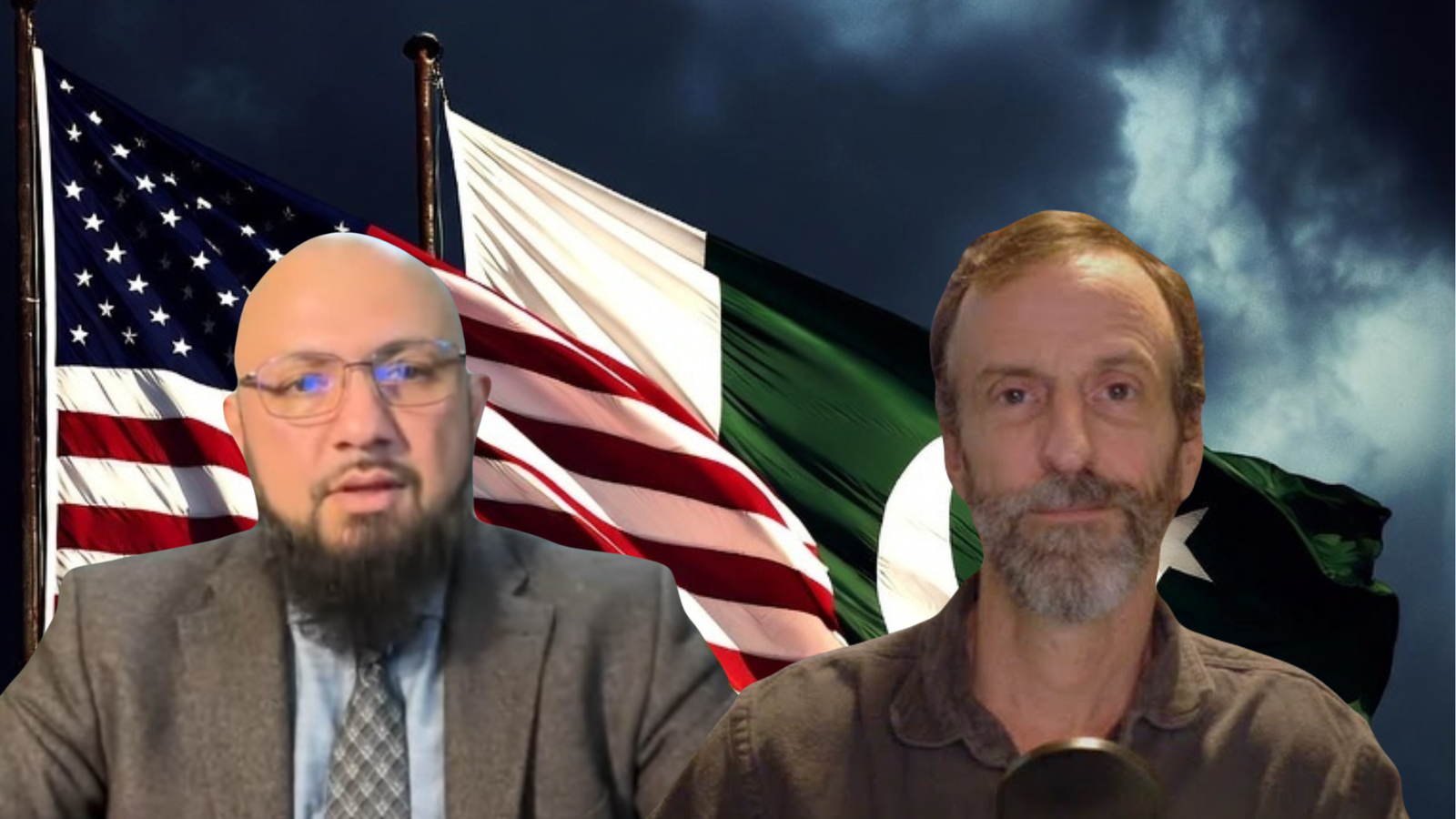
Author and broadcaster Scott Horton joined the Afghan Eye Podcast to examine the evolving dynamics between Afghanistan, Pakistan, and the United States, drawing on his two decades of research into America’s war on terror and the enduring effects of militant patronage across the region. This interview illuminates how post-2021 power struggles continue to reshape South Asia’s geopolitical landscape.
Post-US Withdrawal Uncertainty
Scott Horton, a long-standing libertarian critic of American foreign policy, is director of both The Libertarian Institute and the Scott Horton Academy, and the host of the Scott Horton Show, a daily interview programme that has, over the course of twenty years, documented the United States’ entanglement in global conflicts. He is also the author of several influential books, including A Fool’s Errand: Time to End the War in Afghanistan, Enough Already: Time to End the War on Terror, and Provoked: How Washington Started the New Cold War with Russia and the Catastrophe in Ukraine.
Horton approaches American warfare through a strict anti-interventionist lens. True to his libertarian worldview, he argues that large, militarised states inevitably produce self-justifying conflicts, and that open-ended deployments abroad only multiply the forces they claim to contain. This perspective frames his understanding of South Asia today.
Asked about recent tensions between Afghanistan and Pakistan, including border exchanges and allegations of proxy activity, Horton emphasised the extent to which the entire region is still living in the shadow of the American occupation. For him, the present crises cannot be separated from the structures, incentives, and violent networks that Washington helped entrench during its twenty-year campaign.
Militant Blowback and Pakistan’s Historical Strategy
A major theme of the conversation centres on Pakistan’s long-term use of armed groups along the Durand Line. The podcast host, Sangar Paykhar, traces how tribal regions in north-western Pakistan have, for more than a century, served as a recruitment ground for irregular fighters. Whether against the British Empire, in Kashmir, or during the anti-Soviet war in Afghanistan, local militias became instruments of state strategy despite lacking development, governance, or economic opportunity.
Horton agrees with Paykhar’s assessment that once a state creates or sponsors armed groups, they evolve beyond control. “You cannot forever control an organisation as a pawn,” as Paykhar notes, a point Horton affirms. Militancy, especially when cultivated as a tool of regional influence, eventually produces blowback.
The emergence of the Tehreek-e-Taliban Pakistan (TTP) illustrates this. Paykhar outlines how years of Pakistani military operations, conducted partly to satisfy American pressure following the invasion of Afghanistan, pushed segments of Pakistan’s own Pashtun population into confrontation with the state. Pakistan had once encouraged these men to fight across the Durand Line; now it demanded that they stand down. The confusion and resentment among tribal communities contributed directly to the formation of the TTP movement, whose factions have since turned their guns inward.
Horton underscores that while Western observers often treat militant groups as neatly aligned proxies, the reality is far more complicated. Networks often overlap, leaders defect or reassert autonomy, and groups evolve into new entities, as seen in the rise of Islamic State-Khorasan, which emerged partly from militants once supported by Afghan intelligence under the previous Afghan Republic. The shifting allegiances, he argues, frustrate attempts to impose tidy narratives about control.
The TTP Question and Accusations Against Kabul
A central question Scott Horton poses is whether Pakistan genuinely believes that the Afghan Taliban, alongside India, is using the TTP as a proxy against Islamabad. Paykhar argues that such allegations are implausible given Afghanistan’s strategic and economic realities. Afghanistan is landlocked, in urgent need of trade routes, and deeply dependent on access through Pakistan to the Indian Ocean. Kabul, he notes, has been expanding its commercial ties with Central Asia, Iran, and India in an attempt to stabilise an economy that collapsed after the Western withdrawal. The notion that Afghanistan would jeopardise its fragile economic lifelines by supporting anti-Pakistan militancy strikes him as untenable.
Horton presses Paykhar on whether Islamabad itself believes its own accusations. Paykhar responds that Pakistan’s military establishment may view periodic militancy as a “manageable risk”, a tolerable level of instability that can be used to attract American attention and potentially secure renewed financial support. With Pakistan facing severe economic deterioration, widespread corruption, and diminishing international investment, its generals may believe that renewed US security funding is essential. In this reading, allegations against Kabul serve less as a genuine security concern and more as a political tool to position Pakistan as indispensable to Washington.
Washington’s Waning Interest in Afghanistan
On whether the United States might respond to such manoeuvring, Horton is unequivocal: Washington is not interested in returning to Afghanistan. He dismisses speculation that Donald Trump seeks to recapture Bagram Air Base or to initiate a new Afghan campaign. While political rhetoric in the United States occasionally indulges fantasies of regained strategic footholds, Horton argues that there is no genuine appetite for restarting a war that lasted twenty years and ended in humiliation.
Indeed, he stresses that even in strategic terms, Bagram offers little of value. It cannot serve as a base for nuclear weapons; it is unnecessary for operations against Iran; and it adds no meaningful advantage against China or Russia. The only conceivable argument would be to use Bagram as a launching point to secure Pakistani nuclear assets in the event of a crisis. According to him, even this is implausible, given that Pakistan and the United States already have long-established emergency protocols designed precisely for such scenarios.
From Washington’s vantage point, Afghanistan is simply too distant, too costly, and too strategically marginal to justify renewed involvement. Horton’s conclusion is blunt: the United States should stay out, and it intends to.
China, India, and the Emerging Competition in Central Asia
The conversation widens to consider how broader geopolitical shifts, especially the US focus on China, shape South Asia’s strategic environment. Paykhar references the work of American strategist Elbridge Colby, a key advocate of the “pivot to Asia,” who argues that the US should rely on regional actors to contain China. Paykhar earlier believed that India, with its ties to Washington under Trump, might become the primary partner in this effort.
However, he now observes that India’s position is more complex. Far from aligning wholeheartedly with Trump, New Delhi appears to be distancing itself from his agenda. At the same time, some Pakistani commentators speculate that Islamabad is positioning itself as a preferred partner for Washington, possibly by signalling a willingness to counter Chinese influence.
Horton is cautious about such theories. While he accepts that they “fit” the general logic of US strategy, disrupting Central Asian connectivity to slow China’s westward expansion, he cannot confirm that such coordination is taking place. He notes that Pakistan’s longstanding partnership with China, especially against India, makes a decisive turn toward Washington unlikely. Islamabad, he suggests, will instead continue to balance its relationships, seeking advantage from both Beijing and Washington without committing fully to either.
Likewise, he views India’s dilemmas as part of a broader pattern. India wishes to counter China but has historically depended on Russian arms and maintains its own independent geopolitical calculus. The result is a region caught between rivalries, with each state seeking to hedge rather than declare allegiance.
Fragmented Power and the Legacy of Intervention
A recurring point throughout Horton’s remarks is the fragmentation of power across Afghanistan and Pakistan. Neither government holds absolute control over all armed actors within its territory. This multiplicity of militant groups, some historically linked to intelligence services, others pursuing independent ambitions, creates an environment in which small factions can ignite regional crises.
Horton points to past incidents, such as attacks in Kashmir, where militant groups acted without direct orders from Pakistani intelligence, triggering dangerous escalations between nuclear-armed states. He stresses that even when an organisation originates as a proxy, its fighters remain autonomous individuals capable of acting outside the state’s instructions.
For Horton, this is part of the broader tragedy of interventionist policy. Whether sponsored by Pakistan, the Afghan Republic, or the United States, armed groups develop their own logic, motivations, and trajectories. Once unleashed, they reshape the political landscape in ways their creators cannot foresee. The result is today’s intricate and often opaque mosaic of competing networks.
Horton’s libertarian scepticism of militarised statecraft leads him to emphasise the unintended consequences of intervention, while Paykhar’s regional analysis situates these dynamics within a century-long continuum of political manipulation and militant mobilisation along the Durand Line.
Together, their dialogue highlights a core truth: post-war Afghanistan and Pakistan are still navigating landscapes shaped by the legacies of foreign intervention, internal contradictions, and shifting global priorities. Understanding these forces is essential to grasping the evolving balance of power across South and Central Asia.
