
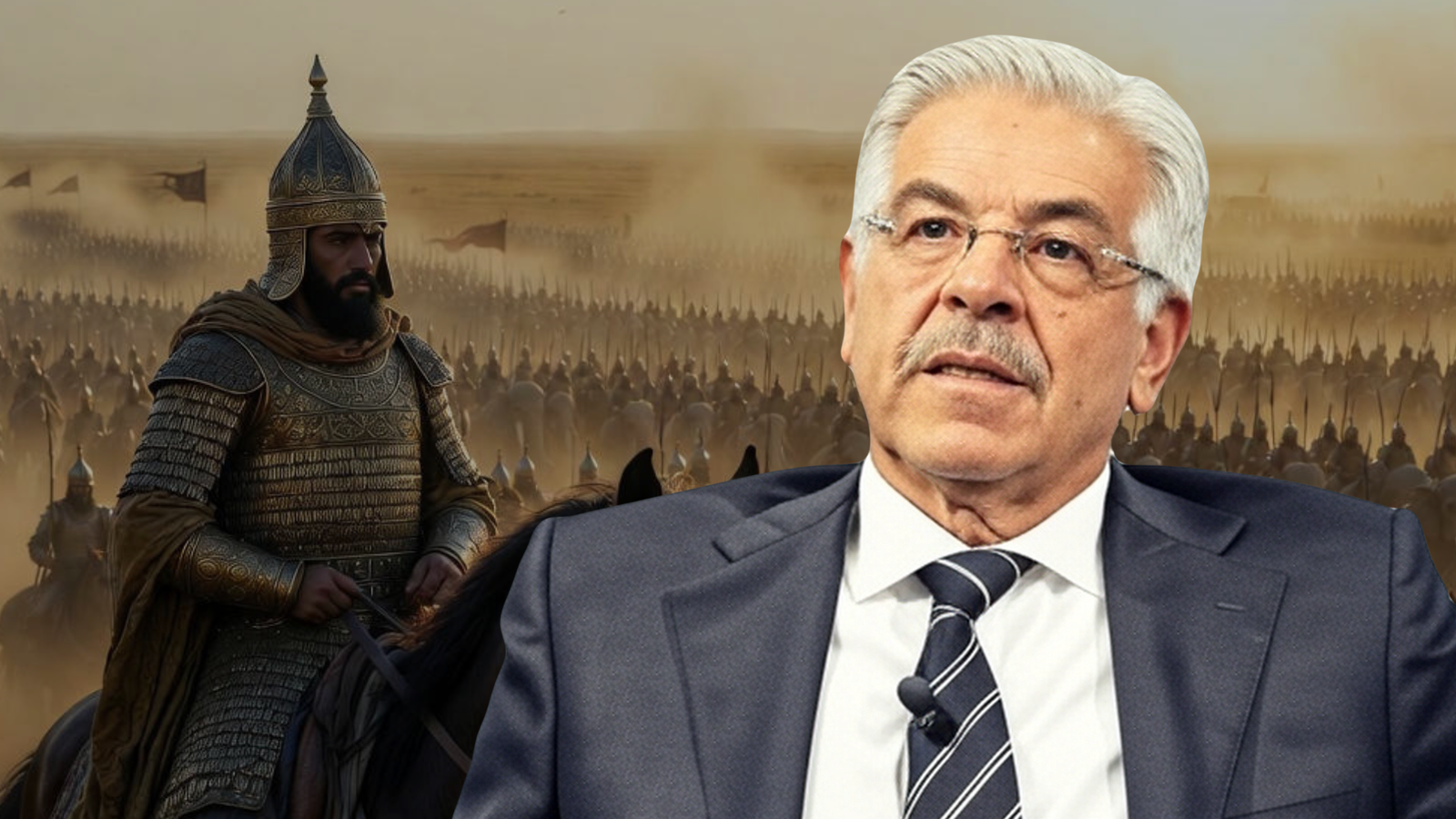
Khawaja Asif’s attacks on Mahmud Ghaznawi before and after October 2025’s conflict with Afghanistan exposed an identity crisis deepening under Afghan–Pakistan tensions.
Rhetorical War
In 2024, after years of escalating tensions, Pakistan Defence Minister Khawaja Asif publicly derided 11th century Turkic-Afghan emperor Sultan Mahmud Ghaznawi. Known for his abrasive style and blunt gaffes, Asif referred to Ghaznawi, widely considered a scion of Islam who aided its spread in the subcontinent, as a plunderer. Asif publicly questioned Pakistan’s longstanding practice of naming missiles after medieval rulers overwhelmingly based from Afghanistan, Ghaznawi amongst them. His comments were widely reported and debated inside Pakistan and abroad, including in Indian and Afghan media.
The Afghan state sees itself as the successor state to a long line of Central Asian conquerors amongst whom Mahmud Ghaznawi ranks highly. It therefore responded quickly and angrily. In December 2024, Afghanistan’s state broadcaster RTA carried an official statement condemning Asif’s remarks as ‘disrespectful’ and ‘ignorant’ of history, underlining that Mahmud Ghaznawi is regarded by many Afghans as a foundational Muslim ruler and a source of pride. The dispute quickly rose in prominence. Indian media picked up the story. The Times of India even asked whether Asif’s comments signalled a broader foreign-policy shift away from Afghanistan-centred historical references in Pakistan’s strategic culture.
In the same breath, Asif and other officials continued to recycle familiar accusations that Afghanistan and India jointly enable militancy on Pakistani soil, linking Kabul and New Delhi to groups such as the Tehreek-e-Taliban Pakistan (TTP) and the Balochistan Liberation Army (BLA). These claims have become a reflex in Islamabad’s political discourse.
These allegations were neither new nor groundbreaking, as Pakistan had levelled the same charges at Kabul throughout the course of the American occupation. The allegation against Kabul was old but what was different was that this time, it was levelled against the Taliban. As a group comprising Baloch Afghans under the wider embodiment of their characteristically traditionalist Islam, the claim of Taliban alignment with a Marxist-nationalist insurgency such as the BLA raised eyebrows. The pairs’ ideological foundations, recruitment bases, and strategic aims diverge entirely. The Taliban seeks a Sharia based order rooted in Sunni revivalist discourse; the BLA espouses an avowedly secular and ethnonationalist project that would itself lay covetous eyes on Afghan territory, much of it the Taliban’s own heartland. Suffice to say, there seems little to no coherent ideological or organisational framework for sustained cooperation.
That accusation was surpassed in spectacularity by its related claim that the Taliban and a Hindu nationalist government in India were in cahoots and shared a joint strategy against Pakistan. Whilst inflammatory, that accusation has lost much of its potency throughout the years. Not only has Islamabad used it ad infinitum against Kabul, irrespective of who rules, but the accusation also seems reserved for Kabul alone. Bellicosity toward Delhi’s regional partners is conspicuously absent when pertaining to other states, the UAE and Saudi Arabia foremost amongst them. In the latter instance, Riyadh’s warm ties with India did not constitute any hurdle for Islamabad in hurrying to sign a defence pact with it.
The claim’s spectacularity was complete by the fact Hindutva project in New Delhi defines itself as against political Islam and, in particular, based on a historical grudge against the very Central Asian Islamic emperors who the Taliban view themselves as the inheritors of. To imagine a stable triangle connecting the Taliban, the BLA, and the BJP government in Delhi requires ignoring almost everything about their internal worldviews.
On 9th October 2025, Pakistan launched airstrikes in Kabul and several eastern Afghan provinces, ostensibly targeting TTP elements. Afghan and international reporting indicate that these strikes largely killed Afghan civilians. In response, Kabul mounted large scale attacks on Pakistani positions along the Durand Line from 11th October onward. The ensuing fighting, now widely referred to as the 2025 Afghanistan–Pakistan conflict, lasted roughly ten days and left scores of soldiers and civilians dead or wounded on both sides. Subsequent reporting by international outlets, including Reuters and others, described the episode as the worst bout of violence between the two neighbours since 2021 and noted that a fragile ceasefire was eventually brokered with external mediation.
Asif doubled down following the conflict. Speaking to the liberal-inclined Pakistan Experience podcast weeks after the conflict, he decried the lack of a ‘national narrative’ in Pakistan’s historical curriculum. He also criticised the glorification of foreign heroes at the expense of local figures.
A stepping stone
The continuity between Asif remarks and the October 2025 conflict is stark. His earlier accusations against Afghanistan and India were not new. Taken together with his attempt to recast iconic Afghan rulers as mere looters, however, this helped prepare the political ground for viewing Afghanistan as a hostile incubator of Pakistan’s problems, old and contemporary, whose refugees deserved indiscriminate deportations to boot. When Pakistan threw the dice on 9th October and crossed into Afghan airspace, it did so within a broader narrative frame: a frame which attempted to taint with an Afghan brush in asserting its indigeneity and externalising its domestic security woes alike.
Seen in this wider context, Asif’s assault on Mahmud Ghaznawi was no mere historical footnote. It strikes at the heart of how Pakistan has imagined itself since 1947. The strong Afghan response to his comment and defence of Ghaznawi now looks less like a symbolic quarrel or inflamed national sentiment. It appears more as foresight in understanding the deeper implications of Pakistan’s identity drift.
From the early decades of the state, Pakistani textbooks, speeches, and monuments have glorified figures such as Mahmud Ghaznawi, Muhammad Ghori, Alauddin Khilji, Zahir ud-Din Babur and Ahmad Shah Abdali. These rulers were presented as precursors to Pakistan, their campaigns into the subcontinent framed as early expressions of a distinct Muslim political will that would eventually culminate in the creation of a separate Muslim homeland.
The naming of missiles after Ghaznawi, Ghori, and Abdali was the militarised expression of this mythmaking. These were deliberate attempts to wed Pakistan’s nuclear and conventional power to the continuum of Muslim and, in particular, Central Asian martial glory. The contentiousness of these symbols precisely after a major military confrontation with Afghanistan was not accidental. When Khawaja Asif publicly demoted Ghaznawi to a plunderer, suggesting that such names be removed from Pakistan’s arsenal, he was therefore doing more than rewriting a footnote. He was severing Pakistan from a key narrative strand that had sustained its self-image for decades, but a strand that had grown untenable in light of hostilities with Kabul.
A precursor to this symbolic tension was apparent in 2019 when a statue of 19th century Sikh Maharaja Ranjit Singh was controversially unveiled in Lahore Fort, vandalised, but unveiled once more in a different location last year. Singh had carved a short-lived Sikh Empire in Punjab after seizing control of Lahore and Peshawar from his erstwhile Afghan overlords who had collapsed into infighting. Amongst other overtly anti-Islamic measures, Singh had banned cow slaughter, the Muslim call to prayer (adhaan) and desecrated mosques. Yet, due to his Punjabi origin, Singh cut a palatable enough figure for glorification in the Islamic state established to ostensibly forestall any subsequent incarnation of him.
The Narcissism of Small Differences
The irony is that this identity shift is hardly a Pakistani chauvinism. It instead brings Pakistan closer, not further, from the very Hindutva project in India it defines itself in opposition to and accuses Kabul of complicity in. As Pakistan once identified itself in opposition to India. Asif now sought to redefine it in opposition to Kabul, but inadvertently in alignment with India. Full circle.
For years, Hindu nationalist forces have pursued a systematic campaign to minimise or recast Islamic Indian history. This has involved rewriting school curricula, renaming cities, and altering the symbolic landscape through demeaning cinematic portrayal of the Muslim (and Afghan) emperors who once invaded and ruled India’s vast plains. Allahabad’s renaming to Prayagraj, the change of Mughal-era roads and districts, and repeated attempts to describe the Mughal Empire as an unmitigated ‘foreign occupation’ are part of this zeitgeist. The prerequisite for constructing an unbroken Hindu civilisational narrative stretching from antiquity to the present is the reduction of Islamic polities to unwelcome and foreign interruptions.
Pakistan’s ruling elites have traditionally decried this as insecure. Therein lies the irony. By defining itself as a fortress of Islam in opposition to Hindu India, Asif’s dismissal of Ghaznawi as a rapacious looter is an adoption of New Delhi’s modus operandi. Where Hindutva attempts to detach India from its Indo-Islamic and Mughal past, Asif’s line of thinking asks Pakistan to detach from the roots planted by its Afghan–Turko-Persian anchors. Yesterday’s spiritually native hero becomes today’s genealogically foreign villain when political convenience demands it. The comparison is therefore unavoidable. The very Defence Minister of Pakistan, which once prided itself on being the custodian of the subcontinent’s Muslim heritage, now echoes the revisionism it long condemned in New Delhi.
A Long Afghan Shadow: in Love and War
Pakistan’s national narrative has never been purely South Asian. Its very name and anthem gestures towards a wider Muslim geography; its ideological justification has rested on the idea of a Muslim polity distinct from, and in some sense superior to, the Hindu-majority India it left behind. This was not restricted to history, but incorporated geography and identity. By tethering itself to Ghazni, Ghor, Kandahar and distant Bukhara beyond, Pakistan sought to project a lineage that transcended its South Asian confines.
Rather than relying alone on the broader Indo-Muslim civilisation centred in Delhi, Lucknow, Hyderabad and other urban centres, Pakistan preferred also to latch onto an Afghan–Turko-Persian genealogy that felt more assertively ‘Islamic’ by virtue of its relative distance from an India whose simplistic reduction to Hinduism was necessitated by Pakistan’s shaky raison d’etre. That story has always relied heavily on extra-Indian references, prominently including Afghan dynasties and conquerors.
In its latest escalations through deporting Afghan refugees and adopting a quasi-war footing toward Afghanistan, Asif sought to control the narrative. Externally, he blamed Afghanistan and India for militancy. Internally, he has busied himself with attempting to uproot Afghan refugees and historical symbols alike, based on their seeming threat to Pakistan’s military junta. In both episodes, the attempt failed to resolve the underlying tension. Afghanistan remains both an indispensable part of Pakistan’s imagined past and a central actor in its security present.
Inasmuch as retaining Ghaznawi, Ghori, and Abdali as heroic figures is accepting an intimate historical entanglement with Afghanistan, their renunciation is to expose the fragility of Pakistan’s ideological edifice. Asif’s statements reflect a state at war not with a neighbour, but at increasing unease with its own imagined history and in need of a reckoning over its temporal and geographic place. For Pakistan, the choice is particularly stark: it can continue to rename missiles, revise textbooks, and blame neighbours for militants it once cultivated, or it can confront the internal contradictions that have produced both ideological confusion and strategic instability.
Many in Pakistan, Asif included, would argue that Jinnah’s Two-Nation Theory was no mere theory. It instead codified the pre-existing reality of South Asian Muslim nationhood distinct from Hindu India. Attempts to wipe away the indelible mark of Afghans and Afghanistan from Pakistan, therefore, is to chip away at that claimed Muslim nationhood. Far from Pakistani nationalism, it reinforces the view of India which, according to Asim Munir, ‘never reconciled’ itself to ‘the concept of Pakistan.’ The very concept that Asif is inadvertently trampling over in real time.
Until Islamabad is prepared to address those contradictions honestly, rather than exporting blame to Kabul, New Delhi or a supposed confluence between them, each new crisis along the Durand Line will continue to expose the fragility of its national narrative more than the strength of its deterrent. It is within that context that Afghanistan must calibrate its approach to a troubled neighbour which seems increasingly unable to decide whether to claim or cancel its Afghan past.