
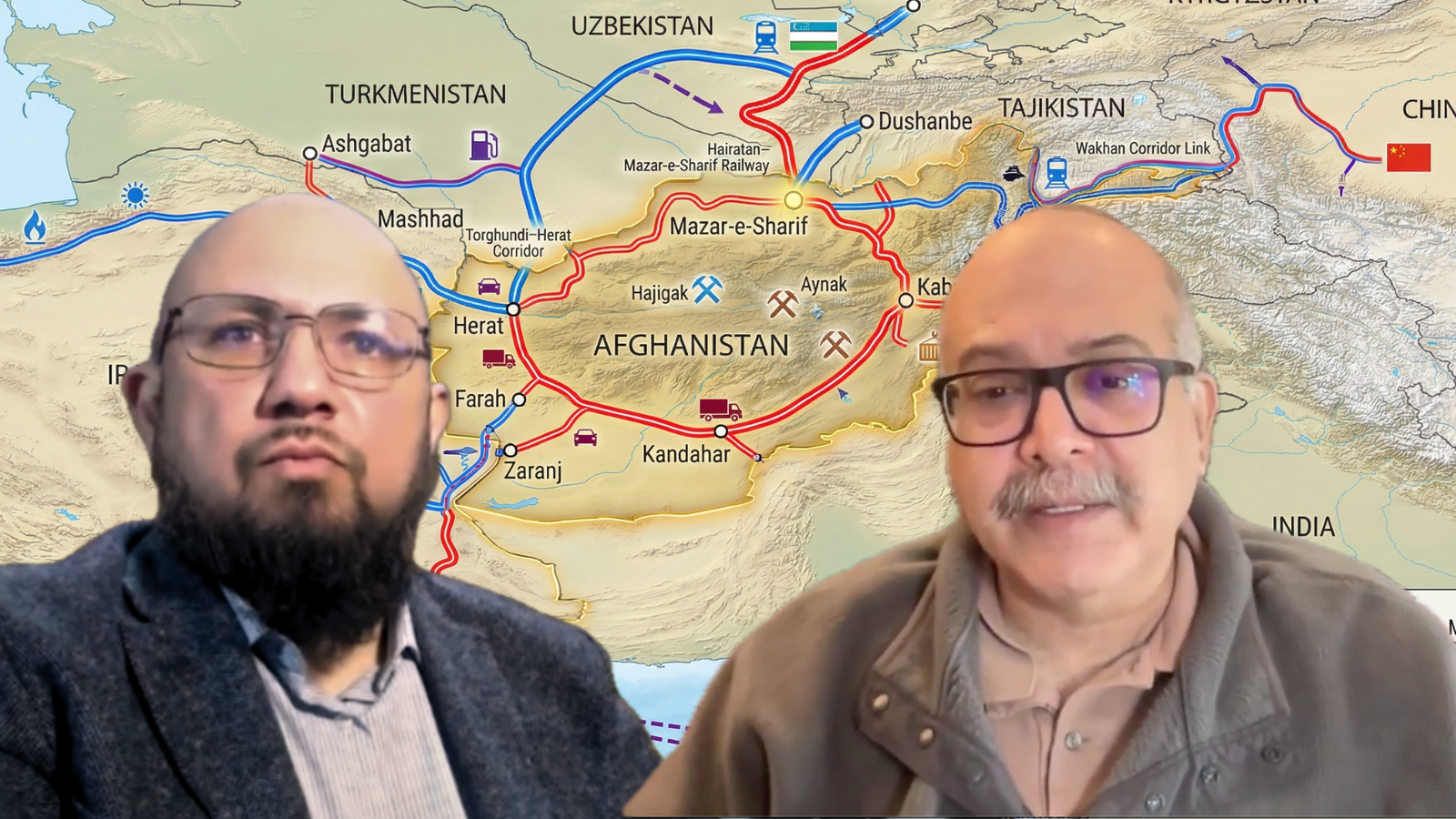
As Afghanistan–Pakistan tensions intensify and India cautiously rebuilds channels with Kabul, Afghan Eye editor Sangar Paykhar speaks with Indian strategist Sushant Sareen about history, pragmatism, and the hard limits of power in South Asia.
A Podcast Framed by a Changing Region
This episode of the Afghan Eye podcast, coming after multiple episodes featuring Pakistani guests, hosts an Indian guest. The episode approaches ongoing developments from a different lens, one that coincides with a moment of genuine regional flux. Bombardment across the Durand Line and deteriorating relations between Kabul and Islamabad have coincided with a renewed India renewed diplomatic presence in Afghanistan. Questions that some armchair observers considered closed after August 2021 have reopened.
Rather than treating Afghanistan as a diplomatic vacuum after the Taliban’s return, Sareen situates it at the centre of a shifting Asian balance, where old assumptions are eroding and new alignments remain fluid. The conversation is both analytical and unapologetically political, reflecting Indian strategic debates rarely aired so openly in Western-facing forums.
India–Afghanistan Relations Beyond 2001
One of the episode’s core arguments is that India–Afghanistan relations cannot be understood through the narrow lens of the post-9/11 era. Sareen repeatedly emphasises that Delhi’s engagement with Kabul is rooted in centuries of interaction, veering between conflict, trade, educational and cultural exchange, and coexistence.
From Mughal-era governance to the Sikh expansion into Peshawar, Afghanistan and the Indian subcontinent have long been intertwined. This historical framing matters, Sareen argues, because it explains why India views Afghanistan not as a distant theatre but as a critical factor in its own regional security.
The implication is clear: India’s interest in Afghanistan did not begin with NATO, nor did it end with the fall of the US-installed regime on 15th August 2021.
Stability as Strategy, Not Slogan
A recurring theme is India’s belief that instability in Afghanistan rarely remains contained. According to Sareen, Delhi’s strategic culture treats Afghanistan as a regional stabiliser or destabiliser by default. When Afghanistan is at war with itself, the shockwaves travel east and north; when it is relatively stable, the region breathes easier.
This logic, Sareen emphasises, underpins India’s longstanding policy of engaging whichever authority governs Kabul, provided basic security assurances are met. Sareen contrasts this with Western approaches that often hinge on conditionality, sanctions, or ideological benchmarks.
In this view, stability is not a reward to be earned but a prerequisite for any meaningful regional order.
Engaging the Taliban: Pragmatism Over Preference
Perhaps the most newsworthy aspect of the discussion is Sareen’s candid assessment of India’s engagement with the Taliban-led government. He rejects the idea that India was strategically “defeated” in Afghanistan in 2021, arguing instead that Delhi adapted faster than many observers expected.
Initial scepticism toward Taliban assurances gradually gave way to cautious re-engagement, particularly after the group pledged not to allow Afghan soil to be used against India. Sareen notes that actions, not rhetoric, shaped Delhi’s recalibration.
He is equally blunt about the limits of this engagement. India does not endorse Taliban ideology, nor does it seek to legitimise its domestic policies. The reverse is widely alleged by apologists for Pakistan’s military junta, but is also equally untrue: Kabul has not and, according to all projections, will not endorse New Delhi’s ideological inclinations. Yet Sareen argues that diplomacy is not a moral endorsement but a tool to manage interests in an imperfect world.
Development as Diplomacy
Another key theme is India’s distinctive development footprint in Afghanistan. Sareen highlights how Indian assistance historically focused on projects identified by Afghans themselves rather than donor-driven priorities.
Hospitals, roads, power infrastructure, and education projects became symbols of a non-intrusive approach that prioritised visibility and utility over political leverage. Even after 2021, India’s continued provision of humanitarian aid: medicines, food supplies, and basic necessities, signals a long-term commitment to the Afghan people rather than any single regime. In the realm of diplomacy, these are cheap investments that reap high rewards, as evidenced by an enduring image amongst Afghans of India’s innocuous role in their country, and in contrast to the perceived nefariousness characteristic of Pakistan’s heavy-handed military junta.
In the current context, this legacy of goodwill explains why India retains relevance in Kabul despite logistical constraints and the absence of formal diplomatic recognition.
Pakistan and the Politics of Control
The sharpest exchanges in the podcast revolve around Pakistan’s role in Afghanistan. Sareen argues that Islamabad’s strategic culture has long been shaped by an expectation of compliance rather than partnership, particularly towards Kabul.
He frames the current deterioration in Taliban–Pakistan relations not as an anomaly but as the logical outcome of decades of coercive policies. From Pakistan’s perspective, influence was often conflated with control; from the Afghan perspective, this bred resentment.
Sareen is particularly critical of Pakistan’s tendency to externalise blame, especially onto India, when faced with internal security crises, including militancy linked to Tehrik-e-Taliban Pakistan (TTP). Labelling Afghan or domestic problems as Indian-backed, he suggests, has become an increasingly dangerous and erratic reflex rather than sober analysis.
Sovereignty and the Limits of Leverage
The discussion on the TTP underscores a broader regional reality: sovereignty places limits on influence, even amongst supposed allies. Sareen argues that Pakistan’s demands for Kabul to ‘crack down’ on the TTP ignore both geography and political reality.
The Afghan Taliban, he notes, may mediate or facilitate dialogue, but they cannot be expected to act as Pakistan’s security subcontractors. This distinction between influence and command is central to understanding why relations have soured so rapidly. The distinction was one, ironically, that Pakistan also used prolifically and correctly during the US occupation in denying the Afghan Taliban were its proxies.
For India, this dynamic reinforces the belief that Afghanistan’s internal politics cannot be micromanaged by external actors without provoking backlash.
Connectivity, Iran and Eurasia
Looking beyond immediate security concerns, the podcast situates Afghanistan within a wider Eurasian economic vision. Sareen points to connectivity projects linking India to Central Asia and Russia via Iran as long-term strategic priorities.
The Chabahar port emerges as a critical node, offering India and Afghanistan an alternative to reliance on Pakistan-controlled routes. Whilst sanctions on Iran remain a significant constraint, Sareen suggests that any easing would unlock substantial regional trade potential.
Afghanistan’s untapped resources, from minerals to agriculture, are presented not as extraction opportunities alone but as entry points into regional supply chains that could anchor long-term stability.
India’s Strategic Rebalancing
Underlying the entire conversation is a broader reassessment of India’s global posture. Sareen argues that Delhi is moving away from overdependence on any single external partner and refocusing on its immediate neighbourhood.
This shift reflects both opportunity and necessity. As global power diffuses and Western influence becomes less predictable, India’s engagement with Afghanistan, Iran, Central Asia, and even Russia takes on renewed significance.
Afghanistan, Sareen argues, is not a peripheral concern but a test case for India’s ability to operate pragmatically in a multipolar Asia.