

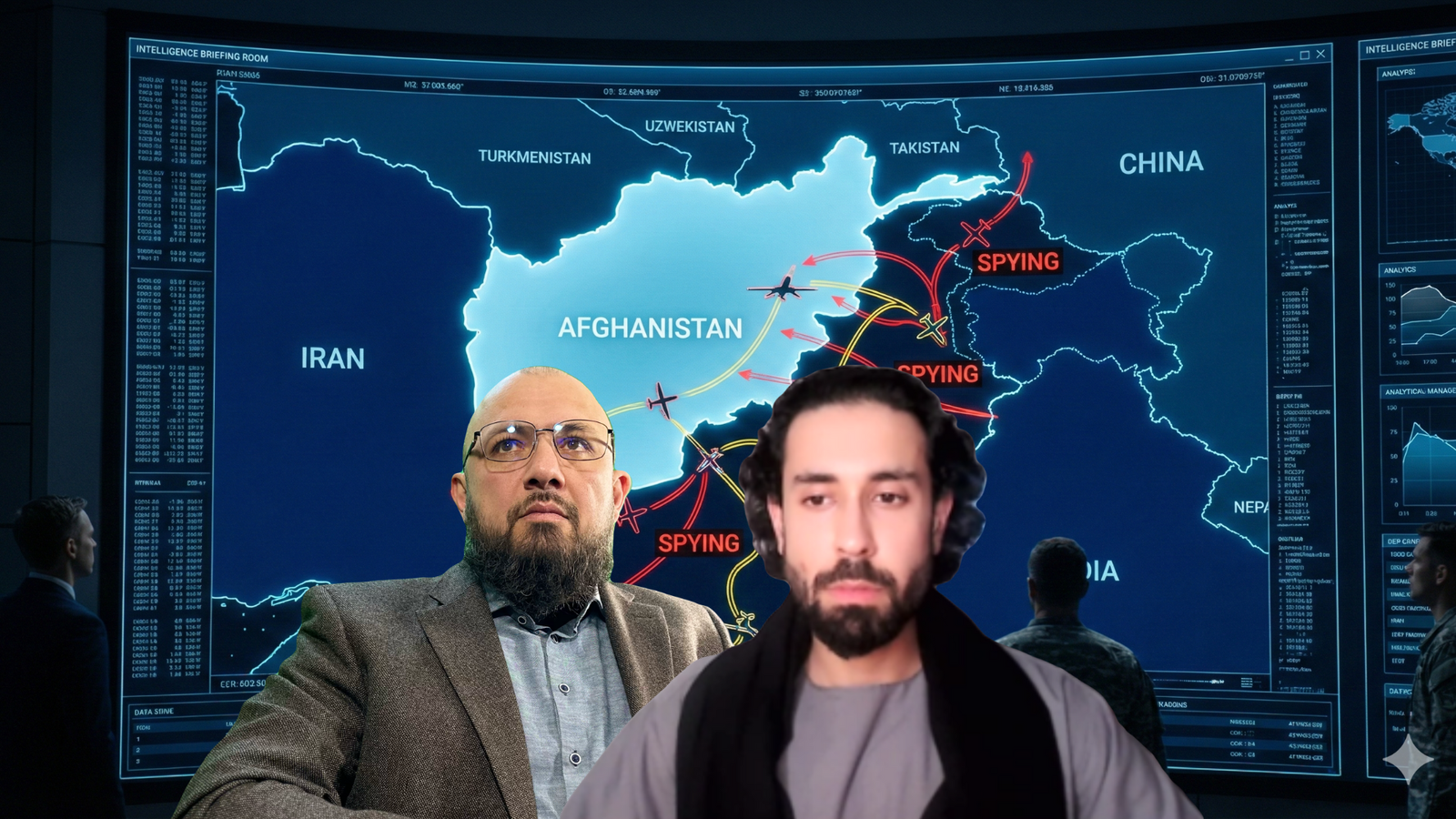
The opening episode of Season 3 of The Afghan Eye Podcast examines newly disclosed US lobbying records that appear to substantiate claims that Pakistan is seeking to internationalise its tensions with Afghanistan and draw Washington back into the region.
On 14 May 2025, as Pakistan faced simultaneous domestic turmoil and external confrontation, a letter quietly reached the US State Department. Its contents, discussed in detail on The Afghan Eye Podcast, have since ignited renewed concern about the risk of another war centred on Afghanistan.
A New Season, a Wider Region
Season Three of The Afghan Eye Podcast opens with an expanded regional lens. Host Sangar Paykhar and analyst Ahmed-Waleed Kakar position Afghanistan not as an isolated crisis state, but as the geopolitical ‘Heart of Asia’: a country whose stability or destabilisation directly affects Central Asia, South Asia, and the Middle East. In turn, regional trends and patterns also have a direct impact on the country.
Contrary to dominant international narratives, the episode argues that Afghanistan today represents a rare point of relative stability in a region marked by mass protests, legitimacy crises, and interstate tensions. It is precisely this stability, the hosts suggest, that makes Afghanistan a target for renewed problematisation.
The FARA Disclosure: Evidence from Washington
At the centre of the episode is a disclosure under the United States’ Foreign Agents Registration Act (FARA), revealing that Pakistan has retained the lobbying firm Squire Patton Boggs to advocate its interests in Washington on matters directly related to Afghanistan.
For The Afghan Eye, this document is more than routine lobbying. It is treated as corroborating years of reporting as well as expert testimony aired on the podcast; Pakistan’s military leadership is actively seeking to reframe Afghanistan as a global counterterrorism threat in order to justify renewed external intervention.
The significance lies not only in the content, but the source. These claims do not originate from Afghan officials or regional rivals, but from Pakistan’s own registered agents communicating with the US State Department; the hosts describe this as a ‘smoking gun’ and as evidence ‘from the horse’s mouth.’
Counterterrorism as Strategy, Not Solution
A major theme of the episode is the use of counterterrorism as a political instrument. Pakistan’s lobbying pitch emphasises cooperation against ISIS-K and the Tehreek-e-Taliban Pakistan (TTP), portraying these groups as Afghan-based threats requiring international action.
The hosts challenge this framing on several grounds. First, they argue that Pakistan has consistently externalised its internal insurgencies, positing itself as a conduit for global counterterrorism efforts, whilst deflecting attention from domestic political, religious, and governance failures. Second, they note that senior Pakistani politicians themselves have publicly questioned the logic of blaming Afghanistan, particularly after the costly fencing of the Durand Line failed to prevent attacks.
In this telling, counterterrorism becomes less a security imperative than diplomatic currency in exchange for political legitimacy, military partnerships, and financial flows from abroad.
Why Pakistan Wants the US Back
The episode devotes considerable attention to motive. Why, after two decades of conflict, would Pakistan seek to facilitate a renewed US role in Afghanistan?
According to the analysis presented, the answer lies in strategic incentives. A foreign military presence would once again position Pakistan as a logistical hub, restore its status as a ‘major non-NATO ally’, and provide leverage in its rivalry with India. It would also, crucially, offer an external explanation for Pakistan’s internal crises at a time when its military faces unprecedented domestic opposition.
The timing of the lobbying effort, which coinciding with heightened India–Pakistan tensions, is presented as further evidence that Afghanistan is being instrumentalised within a broader strategic calculus.
Religious Legitimacy and Ideological Contradictions
One of the episode’s most striking sections explores the religious dimension of Pakistan’s policy. Pakistani military leaders, the hosts argue, frequently invoke Islamic authority, obedience, and unity when addressing domestic audiences. Yet the same leadership seeks assistance from a non-Muslim power to destabilise a neighbouring Muslim polity.
This contradiction, The Afghan Eye suggests, deepens Pakistan’s religious legitimacy crisis, particularly among constituencies already sceptical of military rule. The discussion does not seek to adjudicate theology, but to explain why official narratives struggle to resonate within Pakistan itself.
Information Warfare and Narrative Amplification
Beyond diplomacy and theology, the episode highlights the role of information warfare. Pakistani talking points that routinely depict Afghanistan as a hub for dozens of militant groups, are in fact shown to circulate through international media, UN mechanisms. Even unlikely Western influencers, including Stephen Yaxley Lennon, more commonly known as Tommy Robinson, have regurgitated Pakistan’s talking points. Robinson is a far-right and vociferously anti-Islam activist with the ironic history of amplifying negative stereotypes of Pakistani communities in the UK, and along criminal record that includes convictions for assault, using a false passport to enter the United States, mortgage fraud and multiple contempt of court offences.
Particular concern is raised about the increasing emphasis on ethnicity in international reporting, especially portrayals of Afghanistan as a ‘Pashtun-dominated’ state. The hosts argue that such framing reflects Pakistan’s own internal anxieties and is selectively amplified to delegitimise Kabul rather than to illuminate Afghan realities.
The United Nations and Institutional Pathways
The discussion extends to multilateral institutions. The Afghan Eye scrutinises the production and circulation of UN monitoring reports, noting how language first deployed in Pakistani rhetoric reappears in official UN documents.
The episode raises uncomfortable questions about how such reports are authored, transmitted, and politicised, especially when states with direct interests occupy influential positions within sanctions and monitoring frameworks. While stopping short of alleging conspiracy, the hosts argue that structural bias and agenda-setting deserve closer scrutiny.
Afghanistan as a “Sacrificial Lamb”
The episode concludes with a stark assessment. Pakistan’s military establishment, facing declining legitimacy at home and waning relevance abroad, appears willing to problematise Afghanistan once more to restore its strategic centrality.
Afghanistan, in this view, is not the source of regional instability but its convenient scapegoat or, as the hosts term it, a ‘sacrificial lamb’ offered to global powers in exchange for renewed attention, resources, and influence.
