
Having trouble viewing below?
Click here to open PDF directly
Pakistan’s Forever War on Afghanistan: How the Military Engineered the 2026 Conflict to Survive
Abstract
In February 2026, conventional warfare erupted between Pakistan and Afghanistan following years of escalating violence. Islamabad justified its military operations by alleging that Kabul is actively sponsoring the Tehreek-e-Taliban Pakistan (TTP). Through a qualitative synthesis of conflict tracking data, institutional policy reports, macroeconomic indicators, and critical discourse analysis of official rhetoric, this article interrogates the empirical basis of that claim. It examines the logical tensions within Pakistan’s narrative, including the state’s own construction of a heavily militarised $500 million fence along the Durand Line and its documented role in resettling TTP commanders within its territory. The article situates these security dynamics within Pakistan’s broader domestic crisis: economic contraction, the politically contested removal of Prime Minister Imran Khan, and the erosion of foreign patronage after the collapse of the American occupation of Afghanistan. The analysis argues that the conflict is better understood as one which is incentivised by and a product of institutional desperation and geopolitical realignment than simply of militancy. Pakistan’s military establishment has sought to restore its historical position as an American strategic partner by calibrating its operations to the demands of the second Trump administration. The article offers a framework for understanding the war’s underlying drivers beyond Islamabad’s official justifications, with implications for international mediation, aid conditionality, and the credibility of Pakistan’s representations to the United Nations Security Council.
Introduction
On 9 October 2025, Pakistan conducted an airstrike on Kabul, claiming to have targeted (TTP) leader Mufti Nur Wali Mehsud (Khattak, 2025). The strike occurred as Afghanistan’s Foreign Minister Amir Khan Muttaqi arrived in New Delhi for the first direct diplomatic engagement between Afghanistan and India since the Taliban’s 2021 takeover (Haidar, 2025). Within days, however, Mehsud released a video from Khyber-Pakhtunkhwa rejecting Pakistan’s claims and asserting that TTP operations were restricted to Pakistan rather than Afghan soil (Ariana News, 2025). Yet the airstrike marked a watershed as Pakistan’s first direct military attack on the Afghan capital. Afghanistan condemned the violation of its sovereignty and launched retaliatory strikes, triggering fierce clashes along the Durand Line (International Crisis Group, 2026). On 15 October, the two states reached a ceasefire agreement in Doha, though this respite, mediated by Qatar and Turkiye, would hold for only a few months (International Crisis Group, 2026; Al Jazeera, 2025b).
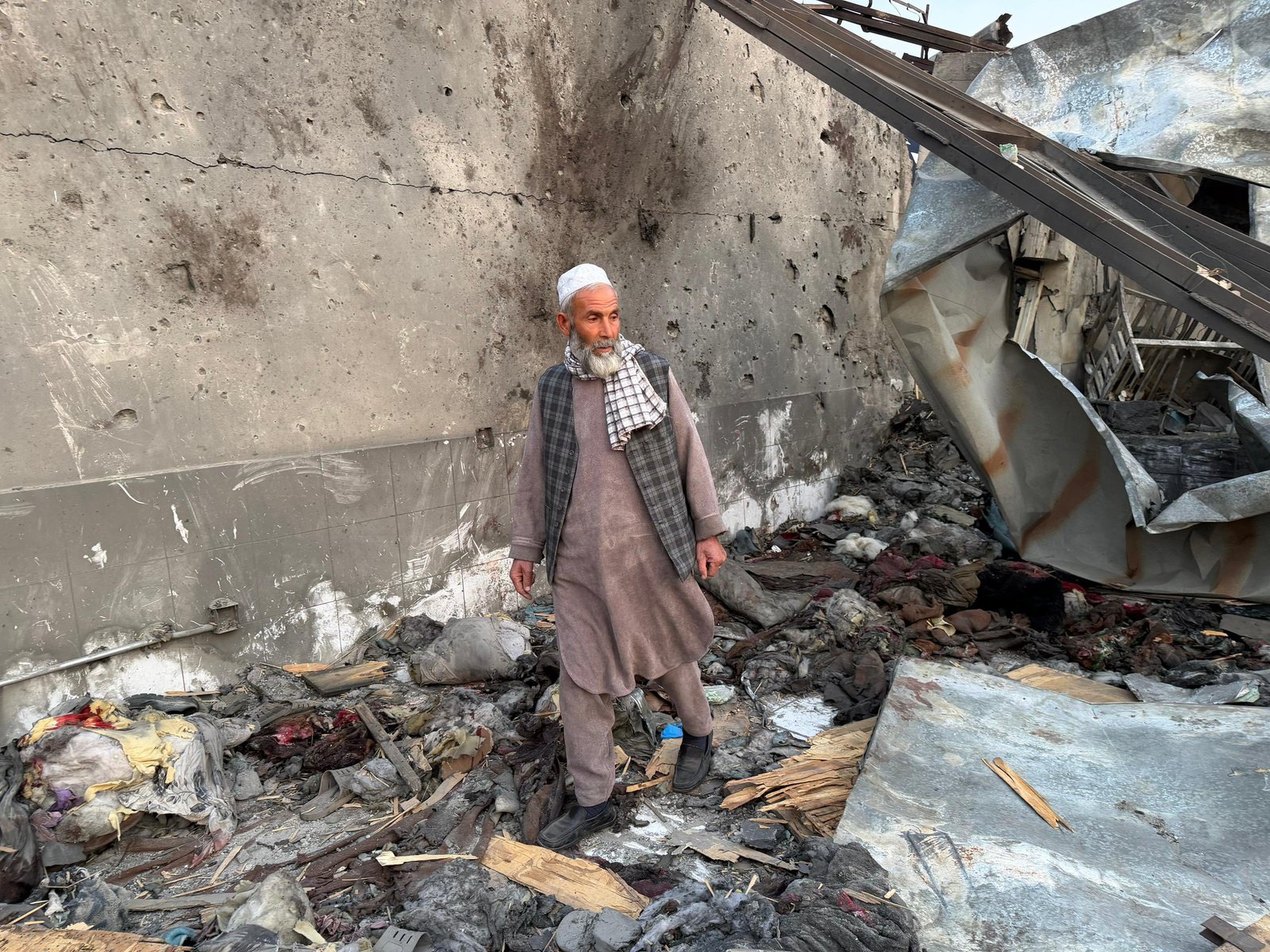
This sustained pattern of escalation reached its breaking point in early 2026, as sporadic skirmishes metastasised into state-on-state combat after Afghan forces launched a retaliatory operation across the Durand Line (TOLOnews, 2026a). This followed Pakistan’s bombardment of eastern Afghanistan on 21 February, which the United Nations Assistance Mission in Afghanistan (UNAMA) reported had caused civilian casualties (Ariana News, 2026). In launching Operation Ghazab Lil-Haq in February 2026, Pakistan’s Defence Minister Khawaja Asif officially declared ‘open war’ on Afghanistan (Al Jazeera, 2026), definitively transitioning the conflict from sporadic attacks to a conventional military confrontation (Maqbool, 2026). Whilst the operation initially featured Pakistani airstrikes (Burke et al., 2026), Afghanistan responded with its own armoured vehicles and heavy weaponry (Al-Monitor, 2026b). The retaliatory Afghan offensive involved drone strikes deep into Pakistani military bases (Indian Defense News, 2026), and the Afghan Ministry of National Defence reported seizing abandoned Pakistani military vehicles and weaponry following the retreat of Pakistani frontier personnel (Kochhar, 2026). Independent monitoring substantiated over 150 severe military clashes between the two states from August 2021 to December 2025 (Armed Conflict Location & Event Data Project [ACLED], 2025).
As with other escalations, Islamabad justified its operations by claiming Kabul actively shelters and sponsors the Tehreek-e-Taliban Pakistan (Palmer & Margolis, 2026). Yet this official justification lacks empirical substantiation; as United Nations experts concluded, ‘Pakistan has not published credible evidence that TTP attacks within its territory were directed or controlled by the de facto Afghan authorities’ (Office of the United Nations High Commissioner for Human Rights [OHCHR], 2026), a reality further compounded by Pakistan’s own construction of a $500 million unilateral fence along the Durand Line. According to accounts of this fence’s construction (Basit, 2021; Dawn, 2019; The Economic Times, 2021), this heavily fortified fence renders the alleged militant infiltration operationally highly improbable.
The latest escalation was long in the making, and represented the culmination of a protracted deterioration in relations over the preceding years. It arrived amidst a severe and unrelenting decline in Pakistan’s domestic stability. The challenges confronting Islamabad include a loss of legitimacy for the military following its collaboration in the US-orchestrated ouster of Imran Khan (Grim & Hussain, 2023). This is compounded by the authoritarianism necessary to contain the political fallout of Khan’s ouster together with severe economic challenges. These economic challenges include a burgeoning national debt and historic record inflation.
Pakistan’s recent history as a rentier state must be examined. Historically, the United States has provided extensive financial and military aid to Pakistan in direct exchange for the Pakistani military, with its track record of rent-seeking, helping to advance American foreign policy objectives. In the political economy sense employed here, rent-seeking refers to the practice of extracting income, resources, or influence through the manipulation of political arrangements rather than through productive economic activity (Siddiqa, 2017). For Pakistan’s military establishment, this has historically taken the form of leveraging its geopolitical position amidst regional instability to extract financial and material support from foreign patrons, whilst using that support to entrench institutional dominance at home. This pattern manifested most explicitly in Islamabad’s airstrike on Bagram Airbase, reported in early 2026 (The Telegraph India, 2026), which was a pointed signal of alignment with Washington’s strategic priorities.
To interrogate Islamabad’s official narrative, this article employs a multi-method approach comprising historical and diplomatic analysis, logical and structural analysis, institutional analysis, macroeconomic analysis, geopolitical analysis, critical discourse analysis, and rhetorical analysis of official statements and FARA lobbying filings. The study integrates empirical evidence from conflict tracking data, international policy reports, World Bank and Treasury data, arms procurement records, and documented evidence of Pakistan’s institutional practices.
The article investigates a central puzzle: what strategic utility does the 2026 military escalation against Afghanistan serve for Pakistan’s institutional establishment? Rather than treating Islamabad’s security justifications as explanatory, the analysis argues that the conflict is better understood as incentivised by acute and potentially existential institutional constraints and geopolitical realignment that reflects enduring patterns in Pakistan’s Afghan foreign policy. By situating the military escalation within the avalanche in Pakistan’s domestic status quo, the institutional vulnerabilities exposed by Imran Khan’s ouster, and the military establishment’s strategic calculation that conflict will restore its relevance to the Trump administration, the article demonstrates that the 2026 war operates primarily as an instrument of institutional survival for Pakistan’s armed forces, not as a rational response to militancy nor as a panacea to the insecurity that, for decades, has plagued Pakistan whilst being instrumentalised by its military.
Pakistan’s Miscalculation After the End of US Occupation
In August 2021, the Taliban ousted the American-backed regime in Kabul and announced the reestablishment of the Islamic Emirate of Afghanistan (IEA) (Zelin, 2021). The victory was warmly received across the political spectrum in Pakistan. Then-Prime Minister Imran Khan, for instance, framed the Taliban’s triumph as a regional victory over Western cultural enslavement (SBS Punjabi, 2021). This was only a microcosm of a wider sense of victory across Pakistan, which stemmed from the military’s hubristic assumption that the Taliban’s victory would actualise the longstanding doctrine of strategic depth (Mahjar-Barducci, 2026), which aimed at the establishment of a compliant regime in Kabul as achieving the twin goals of preventing Indian encirclement and suppressing of Pashtun nationalism.
Immediately following the Taliban’s takeover, the head of Pakistan’s infamous Inter-Services Intelligence (ISI), Lieutenant General Faiz Hameed arrived in Kabul. In August 2022, a senior Taliban official revealed that the object of Hameed’s visit was to advocate the establishment of an ‘inclusive’ government wherein elites from the American occupation, such as those who had fled to Islamabad on the eve of the Taliban’s takeover, would be guaranteed involvement. More pressingly, Faiz also sought to dissuade the Taliban from a looming advance into Panjsher against a newly declared resistance front that had been hastily assembled by the son of the Afghan warlord Ahmad Shah Massoud, whose uncles were in Islamabad (A.-W. Kakar, personal communication, August 2022). Hameed was rebuffed on both fronts, but his visit nonetheless succeeded in achieving the illusion of absolute Pakistani control over the unfolding situation as he assured the frantically-huddled international press that ‘everything [would] be okay.’ (Siddiqui, 2021; International Crisis Group, 2022). As time transpired, the newly-established Islamic Emirate of Afghanistan’s insubordination would become clear as Islamabad fundamentally misjudged the Taliban’s geopolitical trajectory and calculus (International Crisis Group, 2022). The image projected by Hameed was revealed to be an illusion, and a short-lived one to boot.
In particular, Islamabad expected the new government in Kabul to act on a series of demands: suppress the TTP (Dawn, 2025), deny sanctuary to groups hostile to Pakistan (Basit, 2022), and limit what it alleged was militant movement along the Durand Line (Kaura, 2022; Dawn, 2025). The Taliban, having fought a twenty-year war to restore Afghan sovereignty, had no intention of subordinating its security policy to the state that had spent decades attempting to manage it as a client. Kabul therefore either refused the demands or simply denied the allegations that prompted them. This refusal crystallised into an explicit official position. Most recently, the spokesman of the Islamic Emirate of Afghanistan, Zabihullah Mujahid, characterised the TTP as Pakistan’s internal matter, unrelated to Afghanistan, and attributed its formation to the Pakistani military’s actions against its own population (Sarwari, 2025). By the time Islamabad’s leverage over the new government was revealed as negligible, the diplomatic relationship had already deteriorated beyond recovery.
Moreover, the relatively pro-Afghan Imran Khan himself lost the support of his military patrons and was ousted from power, an event that leaked diplomatic cables suggest was instigated by the United States in collusion with the Pakistani military establishment (Middle East Monitor, 2023). This overthrow marked a key rupture in bilateral relations between Afghanistan and Pakistan. Kabul’s refusal to act against the TTP and Islamabad’s inability to compel compliance hardened into mutual recrimination. Over years of escalating tension, the Durand Line transformed into a theatre of conflict. By October 2025, tension escalated into a conflagration between the two nations. Pakistan’s core allegation, that the TTP operates from and enjoys sanctuary in Afghanistan, was the stated casus belli (Fong, 2026).
Kabul’s insubordination also reputationally stung Pakistan, as its enigmatic image cultivated over decades, as the mastermind behind the Taliban, was shattered almost overnight (Kakar, 2026). Animosity defined virtually all facets of the bilateral relationship. Trade crossings were shut routinely until they were unilaterally shut (OHCHR, 2026), and remain so, by Kabul. Moreover, between September 2023 and March 2026, the Government of Pakistan deported or coerced the return of 2,104,479 Afghan nationals (United Nations High Commissioner for Refugees & International Organisation for Migration, 2026). A growing war of words between the neighbours saw Pakistan increasingly castigating Kabul at international fora.
On 10 March 2025, Pakistan’s Permanent Representative to the UN, Ambassador Munir Akram, delivered a highly critical briefing to the Security Council. Akram accused Kabul of active complicity in Pakistan’s worsening violence and explicitly stated that the TTP’s 6,000 fighters operated under Kabul’s direct patronage. Akram further alleged that the TTP was forming an umbrella organisation in Afghanistan to collaborate with Baloch separatist groups to destabilise Pakistan, and citing the massive influx of arms and refugees as direct burdens on Pakistan (Permanent Mission of Pakistan to the United Nations, 2025). Later in the year, the diplomatic offensive continued under Akram’s successor. On 10 December 2025, Ambassador Asim Iftikhar Ahmad addressed the Security Council with similar condemnations, reiterating accusations of Taliban complicity in facilitating terrorism and weapons trading. Ahmad specifically alleged joint training operations between the TTP and the Balochistan Liberation Army on Afghan soil (Dawn News English, 2025). A claim that has not been independently verified and, given the operational secrecy and fundamental ideological tensions between both organisations, remains difficult to corroborate or refute. These systematic public condemnations at the UN served as deliberate diplomatic cover for Pakistan’s subsequent unilateral military escalations into Afghan territory in early 2026\.
The trajectory from Hameed’s confident assurances in 2021 to Ahmad’s accusations at the Security Council in December 2025 laid bare the complete unravelling of Pakistan’s strategic gambit in Afghanistan. What began as an expectation of influence over a Taliban-led government devolved into mutual hostility, with Islamabad’s diplomatic offensive at the UN serving not as a genuine attempt at resolution but as rhetorical preparation for military escalation. By early 2026, the diplomatic cover had been laid; the war could proceed.
Why the TTP Infiltration Claim Is Logistically Untenable
Pakistan’s accusations of Afghan complicity rest on a central claim that its own infrastructure contradicts: the assertion that the TTP infiltrates from Afghan soil. The physical realities along the Durand Line reveal a much more complex picture that belies Islamabad’s prolific claims of TTP infiltration from Afghan sanctuaries. In 2021, Director General of The Pakistani Inter-Services Public Relations (ISPR), Major General Babar Iftikhar proclaimed that Pakistan had successfully sealed the Line with a heavily fortified fence and troop deployments, asserting ‘with authentication’ that ‘no organised terrorist infrastructure’ remained inside Pakistan and that fugitive militants were entirely confined to Afghanistan (The Express Tribune, 2021). Upon completion, the fortification comprised a four-metre-high double chain-link fence packed with concertina wire, an extensive 1,100-kilometre excavation trench and nearly 1,000 heavily monitored forts (Basit, 2021; Syed, 2021). The construction of the barrier proceeded with little regard for local communities, dividing villages and severing centuries-old kinship ties (Akbar, 2024). Beyond the social rupture, the construction destroyed crops and property, whilst the fence itself obstructed the small-scale commerce and seasonal migration upon which local livelihoods depend, devastating the regional economy and fuelling deep resentment against Islamabad on both sides of the Line (Herbert & Idris, 2024).
This formidable infrastructure is reinforced by a substantial military presence that further undermines Islamabad’s infiltration claims. Troop deployments along the Durand Line have grown substantially over time. By 2017 and 2018, Major General Asif Ghafoor, then Director General of the ISPR, publicly stated that approximately 200,000 Pakistani troops had been deployed to secure the frontier with Afghanistan (Gul, 2017; Dawn, 2018). The Civil Armed Forces, specifically the Frontier Corps, manage this continuous presence by monitoring highly fortified checkpoints from Khyber Pakhtunkhwa to the southern deserts of Balochistan (Government Accountability Office [GAO], 2009a). During periods of escalation, the conventional apparatus of the regular Pakistan Army aggressively reinforces this baseline (Rosenau, 2012; Terrorism Monitor, 2008). According to the International Institute for Strategic Studies (IISS, 2026), as of early 2026, Pakistan’s active-duty military strength stands at approximately 660,000 personnel. Direct operational command of Pakistani forces on the Durand Line is bifurcated between two regional headquarters. The XI Corps, headquartered in Peshawar, holds total operational command over the northern sectors. This formation directs military engagements and counter-insurgency operations across Khyber Pakhtunkhwa, coordinating regular infantry divisions and the Frontier Corps to heavily militarise the mountainous region abutting the Afghan provinces of Kunar, Nangarhar, and Khost (Markey, 2008). Meanwhile, the XII Corps operates out of Quetta to command the southern frontier in Balochistan. Focusing heavily on desert warfare, this formation secures the vast southern frontier adjacent to the critical Afghan provinces of Kandahar, Helmand, and Nimruz (Chandra, 2013; Nawaz, 2008).
Islamabad placed this entire western military apparatus on maximum operational alert following the severe clashes in October 2025 and the outbreak of conventional warfare in February 2026 (ACLED, 2025). Heavy artillery regiments and air defence corps reinforced frontline outposts. This pushed the number of deployed troops well beyond the established baseline (ACLED, 2025). This heavily mechanised troop density explicitly mirrors historical counter-insurgency mobilisations (GAO, 2009a).
According to the Pak Institute for Peace Studies (PIPS, 2025), Pakistan experienced 521 terrorist attacks in 2024, averaging 43.4 attacks per month across all groups, with the TTP emerging as the most prolific actor. Crucially, these figures document the positive correlation between militancy and the magnitude of military presence along the Line; in other words when troop deployment along the Durand Line reached its maximum extent, militant activity in Pakistan was not low as the narrative of infiltration would suggest, but highest. This crucial reality renders the narrative self-defeating on its own grounds, as a frontier fortified to this extent and garrisoned by such a sizeable force still sustaining attack volumes of this magnitude cannot coherently be described as a porous conduit for externally based militants. Islamabad’s evidence against Kabul is, in effect, a confession about the depth of its own domestic security failure.
Pakistan’s Role in the TTP’s Domestic Resurgence
This severe internal security failure was the direct consequence of the Pakistani state’s own policy decisions that actively facilitated the TTP’s domestic resurgence. Driven by warnings from Army Chief General Qamar Javed Bajwa, ISI Director General Lieutenant General Nadeem Anjum, and Corps Commander Lieutenant General Faiz Hameed that the TTP might align with the ISKP [the local ISIS/Da’ish franchise] (The Express Tribune, 2022), the state authorised a policy of managed return during the 2022 Kabul-mediated peace talks. Defending the decision, then-Prime Minister Imran Khan starkly framed the rehabilitation of up to 40,000 militants and their dependents as the only alternative to mass executions (BBC News, 2023). Hundreds of TTP militants crossed from Afghanistan to patrol the streets of the Swat Valley and the former Federally Administered Tribal Areas (FATA) (JURIST, 2022). Concurrently, the state released high-profile insurgent commanders such as Muslim Khan from custody (Ajmal, 2022).
The policy continued even after Khan’s ouster once the military took the formal reins of power. The managed return generated immense controversy. Political figures across the Pakistani spectrum criticised it resoundingly. Pakistan’s former Federal Minister for Human Rights, Shireen Mazari directly implicated former Army Chief Qamar Javed Bajwa in the proposal to resettle TTP fighters in the tribal districts (Dawn, 2023). Pashtun nationalist political leaders warned explicitly that such a policy would destabilise the region (Hooda, 2022; Siddique, 2022). Other political actors, including former Prime Minister Imran Khan’s party member Murad Saeed, accused the establishment of initiating the resettlement policy at the behest of the United States to deliberately destabilise the country (Business Recorder, 2022; Reddit, 2023).
Criticism of the policy was not restricted to dissidents. Domestic policy bodies, including the National Counter Terrorism Authority (NACTA) and PIPS, concluded that this state-sanctioned resettlement provided the TTP with the domestic sanctuary required to re-establish a lethal operational footprint within Khyber Pakhtunkhwa (PIPS, 2023). Even following Khan’s ouster, the leadership of the new militarily-assembled government conceded this reality. Defence Minister Khawaja Asif publicly acknowledged in January 2025 that the state’s resettlement policy had been a grave error (Hindustan Times, 2025).
Accounting for Islamabad’s historic facilitation of militancy, the resettlement of TTP fighters cannot be dismissed simply as a misguided policy of appeasement born of naivete. The state laid the groundwork for greater insecurity actively by resettling battle-hardened commanders, whilst other events further inflamed violence. Throughout 2022, Kabul brokered talks between Islamabad and the TTP that produced temporary ceasefires (Al Jazeera, 2022b; Mehsud, 2022). By June, the TTP had promisingly declared an indefinite ceasefire (Al Jazeera, 2022a). Yet during these negotiations in August, key TTP commander and negotiator Omar Khalid Khorasani was assassinated in Afghanistan (Al Jazeera, 2022c; Gul, 2022). There was no official claim of responsibility. However, the widespread belief that Islamabad orchestrated the killing prompted the TTP to accuse Pakistan of negotiating in bad faith (Hussain, 2022). The subsequent uptick in violence ended the negotiations and destabilised the tribal belt, inevitably dragging Afghanistan into the fray (ACLED, 2024).
The trajectory from managed return to assassination to renewed insurgency cannot be read as a sequence of policy failures attributable to external factors. The resettlement of battle-hardened TTP commanders in Khyber Pakhtunkhwa was authorised by the Pakistani military and sanctioned by the civilian government. The assassination of a lead TTP negotiator during active peace talks, widely attributed to Pakistani security services, culminated in the destruction of a promising negotiating framework that Kabul had brokered. The subsequent escalation of TTP violence within Pakistan’s territory is the direct consequence of these domestic choices. Defence Minister Asif’s public admission in January 2025 that the resettlement policy was a grave error constituted an official acknowledgement of Pakistani state responsibility for the insurgency Islamabad now attributes to Afghan sponsorship. The TTP threat confronting Pakistan today is, in substantial measure, a threat that Pakistan created.
How Militancy Sustains Military Dominance
This deliberate engineering of domestic insecurity in Khyber Pakhtunkhwa through the resettlement of the TTP reflects a broader systemic reality. Domestically, the military’s predominance provides an inherent perverse incentive for abetting militancy. Insecurity and the failure of civic politics perpetuate the rationale for the military’s heavy and conspicuously political footprint. At other junctures, calculatedly suppressing militancy allows the military to reap the benefits of being seen to successfully ensure security. This image is projected to both domestic audiences and foreign benefactors alike.
The disproportionate power held by the Pakistani military also securitises virtually all of the country’s foreign relations (Siddiqa, 2017). This is particularly evident with Afghanistan and India, which the military has spent decades attempting to link in a concerted anti-Pakistan conspiracy (Roggio, 2025).
This is exemplified best in groups like Jaish-e-Muhammad, Lashkar-e-Taiba, and Sipah-e-Sahaba. Each has operated with the alleged support of the ISI to advance Pakistan’s foreign policy objectives in Kashmir and Afghanistan, whilst simultaneously developing domestic roots that the state has proven unable or unwilling to sever (Hashim, 2011; Laub et al., 2013; Soomro, 2013). The ISI directly assisted in forming JeM, streamlining Kashmiri militancy and enabling high-profile strikes including the 2016 Pathankot and 2019 Pulwama attacks (NCTC, 2025). Despite official bans, LeT retains state-sanctioned space for recruitment. It raises funds through various front organisations (United Nations Security Council, 2005). Domestically, the military allows sectarian groups like Sipah-e-Sahaba Pakistan (SSP) to periodically enter formal politics. This tactic allows the state to tap into and harness grassroots sentiment otherwise remote from it where internal political engineering becomes expedient. The military establishment also leverages these Deobandi networks to suppress domestic nationalist movements. They provide a reliable recruitment pool for other regional proxy conflicts (Sayed & Hamming, 2023). Consequently, state policy towards these factions remains deeply contradictory and in an unstable disequilibrium between active tolerance and targeted crackdowns (EFSAS, 2018).
The pattern documented across these groups reveals the cumulative cost of Pakistan’s institutionalised approach to militancy. Organisations envisaged or tolerated as instruments of state policy have conversely embedded themselves in Pakistan’s body-politic to an extent that renders their clean separation fatal if not impossible. The military’s oscillation between sponsorship and suppression has not weakened these groups, but entrenched them. What began as calculated strategic assets have become permanent features of Pakistan’s domestic landscape, shaping its politics, sectarian relations, and security environment in ways that extend far beyond their original utility.
Pakistan’s Financial Dependency on American Patronage
The historical trajectory of Pakistan’s military strategy confirms that the same institutional calculus governing its domestic management of militancy has equally shaped its foreign relations, most consequentially through the repeated exploitation of Afghan instability to secure substantial Western financial and military patronage (Fair & Ganguly, 2015). Following the 1979 Soviet invasion, the military government under General Zia-ul-Haq transformed Pakistan into the primary conduit for the international effort to arm the Afghan mujahideen (Petrov-Yoo, 2021). Exploiting its status as a ‘frontline state’, the military bypassed international sanctions to secure billions in security and economic aid, effectively utilising this external patronage to consolidate its domestic dominance and shield itself from internal governance failures (Fair & Ganguly, 2015; Haqqani, 2005). Crucially, by controlling the distribution of aid provided by the United States, Saudi Arabia, and other Western allies, the Inter-Services Intelligence (ISI) ensured that only its preferred factions received significant support, thereby shaping the insurgency to suit Pakistan’s long-term regional interests (Haqqani, 2005). In a hotly contested Afghan rebel landscape, access to logistics and weapons depended on sufficient subservience to Islamabad. The beholdenness of Afghan mujahideen to Pakistan was masterfully exploited as some were propelled to central importance whereas others were marginalised where Pakistani policymakers deemed appropriate according to their interests (Coll, 2004; Haqqani, 2005; Riedel, 2014; Yousaf & Adkin, 2001).
Decades later, Pakistan leveraged the US occupation of Afghanistan to gain the status of a major non-NATO ally (Afzal, 2020). The pattern of leveraging Afghan volatility was replicated during the post-9/11 ‘War on Terror’, where Pakistan provided essential ground lines of communication (GLOCs) for NATO forces whilst concurrently maintaining ties with militant proxies in the frontier regions (Staniland et al., 2018). Through this ‘conflictual world-making’, the military establishment enforced a Western-led order superficially whilst pursuing alternative regional objectives to ensure its continued relevance as a security partner (Zaidi, 2025). Islamabad went further by conducting ruthless operations on its own soil at Washington’s behest. It successfully extracted tens of billions of dollars in financial and material support from the US as reimbursement (Center for American Progress, 2008; Epstein & Kronstadt, 2013). In a CNN interview following the US withdrawal, Prime Minister Imran Khan described Pakistan’s role in the American war effort as that of a ‘hired gun’ (NDTV, 2021). Defence Minister Khawaja Asif was equally forthright, telling Sky News that Islamabad had done ‘the dirty work’ of Washington for over three decades (Sky News, 2025, 9:40).
The financial rewards for this protracted transactional relationship were staggering. According to the Congressional Research Service, Washington disbursed nearly $34 billion in total financial and material support to Pakistan between 2002 and the 2018 aid suspension (Kronstadt, 2023). The Coalition Support Fund (CSF) formed the cornerstone of this pipeline. It allowed the Pentagon to transfer approximately $14.6 billion directly to the Pakistani military to reimburse operational and logistical expenditures carried out at Washington’s behest. Concurrently, Islamabad extracted an additional $19 billion in direct aid, comprising approximately $11 billion in civilian aid and nearly $8 billion in security-related assistance, including Foreign Military Financing to procure American hardware (Kronstadt, 2023). This substantial influx of American capital yielded little benefit for Pakistan beyond entrenching the privileges and gains accrued by its highly insulated, cosmopolitan and profligately rent-seeking class straddling the civilian-military divide (Husain, 2023). This profitable arrangement unravelled when President Trump suspended most security assistance in January 2018, later cancelling a further $300 million in CSF reimbursements, citing Islamabad’s harbouring of the Afghan Taliban and the Haqqani Network (Chappell, 2018; Myre, 2018).
Even whilst Pakistan assisted the US in its invasion of Afghanistan and waged US-orchestrated and US-funded war on its own citizens, it turned a blind eye to Afghan Taliban activity on its soil and maintained a careful relationship with the group (Coll, 2018). This relationship was cemented during periods of mutual strategic alignment; as Carlotta Gall documented, Afghan Taliban leadership actively sent emissaries to persuade Pakistani Taliban factions to ‘join forces and turn their attention to Afghanistan’ (Gall, 2009). This illustrated the extent to which Afghanistan served as a useful outlet to stave off pent-up discontent in Pakistan.
Whilst the rationale and utility of managed insecurity is palpable, the formation of the TTP, as a byproduct of Pakistan’s duplicity (Zaidan, 2013), soon became a serious threat. Pakistan’s gambit in being a US-contractor and simultaneous Afghan Taliban facilitator resulted in an explosion of insecurity and social polarisation that killed tens of thousands of Pakistanis (Watson Institute for International and Public Affairs [WIIA], 2021). Finally, Islamabad’s utility to Washington was dealt a final blow with the US’ embarrassing withdrawal from Afghanistan, to which Pakistan was the main conduit.
Despite promises that a Taliban takeover would herald a wider strategic victory for Islamabad, it decidedly failed to achieve the promised subordinate government in Kabul. Inasmuch as Pakistan lulled itself into an illusory expectation of gratefulness from the Taliban, its Afghan clients had conversely, for decades, exhibited resentment at their exploitation by Islamabad. As far back as the Soviet jihad, Afghan and even foreign Arab volunteers had felt marginalised by what they saw as Pakistan’s cynical and self-serving posture. Hamid and Farrall (2015) document that Pakistan prohibited direct engagement between Afghan mujahideen and foreign supporters, instead monopolising the distribution of all external assistance. The authors argue Pakistan deliberately prolonged the conflict to maintain what it characterised as the optimal level of destabilisation (pp. 40–41). This included such policies as the provision of weapons training for Afghan guerrillas, but cushioned by the refusal to teach them combat tactics. Afghan Minister of Defence Mullah Yaqoob recently bluntly termed this as Afghanistan being akin to ‘a cow’ whose instability Pakistan had long milked. (TOLOnews, 2026b).
In recent times, Pakistan’s junta has publicly admitted its strategic failure; Defence Minister Khawaja Asif told the National Assembly that Pakistan’s involvement in historical Afghan conflicts to appease a superpower was a ‘mistake’ (Raza, 2026), adding that Pakistan had been used as ‘toilet paper’ and discarded by the United States, directly causing the terrorist blowback currently destabilising the country (Asif, 2026).
The Military’s Economic Empire and the Erosion of Civilian Governance
Such catastrophic admissions of strategic failure might normally unravel a ruling institution. Yet the military’s grip on politics and lack of accountability are anchored in durable financial roots within Pakistan, documented most extensively in the work of Ayesha Siddiqa, which illustrates how Pakistan’s militarism originates within the tax-exempt commercial empire managed by the armed forces (Siddiqa, 2017). The Economic Policy and Business Development Wealth Perception Index 2025 ranked the military-run Fauji Foundation as Pakistan’s largest business conglomerate, with a valuation of $5.9 billion ahead of all civilian competitors, commanding assets across banking, agriculture, manufacturing, real estate, education, and retail through tax exemptions, privileged access to state land, and regulatory protections (Profit by Pakistan Today, 2025; Economic Times, 2025). Separately, foreign estimates place the military’s overall business footprint at tens of billions of dollars annually, with military-run conglomerates controlling at least 12% of Pakistan’s land (European Times, 2025). The Fauji Foundation operates within a broader military-corporate complex that includes the Pakistan Navy’s Bahria Foundation and the Air Force’s Shaheen Foundation, which run their own enterprises across sectors ranging from insurance and real estate to shipping and manufacturing (The Print, 2025).
The state systematically insulates these corporations from civilian market competition. The military further entrenched this dominance by acquiring over 100,000 acres of public land throughout 2024 and 2025 under the pretext of agricultural modernisation (CADTM, 2025). Concurrent with this commercial expansion, the military tightened its institutional grip on national economic policy through the Special Investment Facilitation Council (SIFC), through which military officials bypass civilian governance structures to negotiate sovereign wealth investments with Gulf Cooperation Council states and autonomously manage the privatisation of major state assets (Khan, 2025; U.S. Department of State, 2025).
The capture of national economic planning by an institution whose primary interests are corporate and geopolitical rather than developmental produces a predictable outcome: economic instability that the capturing institution then claims the authority to manage. The corollary of such military capitalism is chronic economic malaise. Between 2021 and 2024, severe financial turmoil gripped Pakistan (State Bank of Pakistan [SBP], 2023; International Monetary Fund [IMF], 2024). A devastating macroeconomic contraction saw real GDP contract by 0.6% in the 2023 fiscal year, accompanied by extreme currency devaluation and record inflation peaking at 37.97% in May 2023 (Pakistan Bureau of Statistics [PBS], 2023; World Bank, 2023). This financial storm coincided with a sweeping military-led crackdown on supporters of former Prime Minister Imran Khan (Afzal, 2024b), who had been removed from office through a no-confidence vote in April 2022. A classified diplomatic cable, later published by The Intercept, revealed that US State Department officials had actively encouraged Khan’s removal (Grim & Hussain, 2023a; Grim & Hussain, 2023b). According to the cable, in a meeting on 7 March 2022, US Assistant Secretary of State for South and Central Asian Affairs Donald Lu told Pakistan’s ambassador in Washington, Asad Majeed Khan, that Washington’s grievances with the Khan government could be set aside, “all will be forgiven,” if Khan were removed through a no-confidence vote (Ahmed et al., 2026). Khan was removed on 9 April 2022 in a no-confidence vote backed by Pakistan’s military (Ahmed et al., 2026). Exacerbated by a slide in the country’s political stability, the military’s legitimacy was dealt a serious blow. The military establishment’s efforts to restore a civilian political order relied heavily on the re-elevation of Pakistan’s entrenched political dynasties, a pattern that academic research identifies as a core obstacle to democratic consolidation in the country, characterised by the decline of institutions, personalised governance, and the monopolisation of state resources (Begum, 2025).
Following the February 2024 general elections, the PML-N and PPP formed a coalition government led by Shehbaz Sharif as prime minister, with Nawaz Sharif’s daughter Maryam installed as chief minister of Punjab and PPP co-chairman Asif Ali Zardari assuming the presidency (Afzal, 2024a). The elections were widely condemned as fraudulent. Multiple parties, civil society organisations, and international actors including the United States, United Kingdom, and European Union called for investigations into alleged electoral fraud (Afzal, 2024). The Human Rights Commission of Pakistan concluded that the integrity of the elections had been compromised by both institutional incompetence and pressure from extra-democratic quarters (Gul, 2024). A senior government official in Rawalpindi publicly resigned after admitting his direct involvement in large-scale result manipulation (Al Jazeera, 2024).
Foreign Policy as Military Enterprise
Rather than confronting this cycle of institutional decay, Pakistan’s military establishment has focussed on diplomatic activity rooted in the opportunities presented in aligning itself firmly with a Trump-led White House. Regionally Pakistan hurriedly signed a mutual defence pact with Saudi Arabia in November 2025\. This was followed by Pakistan joining President Trump’s Board of Peace in January 2026 and, by February 2026, it had volunteered troops to help police Gaza in the event of a peace deal (Hagedorn, 2026; Gokmen, 2026; Nawaz, 2025). Even the prospect of normalisation with Israel has, at critical junctures, not been ruled out (Arab News, 2026a). This represents a significant departure from Pakistan’s longstanding foreign policy orientation. Since its founding, Pakistan has maintained a formal position of non-recognition of Israel (Kumaraswamy, 2006), a stance anchored in public religious sentiment, and solidarity with the Palestinian cause (Qadeer et al., 2026). Any move toward normalisation would therefore place the military establishment in direct opposition to one of the most consistent elements of Pakistani public opinion. These moves coincided conspicuously with the killing of pro-Palestinian protestors in Pakistan and the banning of the pro-Palestinian Tehreek-e-Labbayk Pakistan (WION, 2025).
The overtures toward Israel are best understood as the public surfacing of a longer pattern of military-led accommodation. In October 2022, then-Army Chief Qamar Javed Bajwa travelled to Washington to reset bilateral ties and reportedly assured senior Biden administration officials, including Defence Secretary Lloyd Austin and National Security Adviser Jake Sullivan, that Pakistan would limit the range of its missiles to fall short of Israel (Ahmed et al., 2026). That such an assurance was offered by the army chief rather than the elected government further confirms that Pakistan’s most consequential foreign policy commitments have long been and remain negotiated through military rather than civilian channels.
The key catalyst in prompting Pakistan’s flurry of foreign policy activity was a brief and successful clash with India in May 2025. Domestically, then-Army Chief Asim Munir relied on a galvanised patriotic fervour to elevate himself to the rank of a Field Marshal (Sheikh, 2025). This was followed by his promotion to the new position of Chief of Defence Forces and constitutionally enshrined lifelong immunity from prosecution (The Times of India, 2025b). Overseas, the clash prompted the junta to launch state-backed English-language news channels as well as bypass conventional avenues of diplomacy by focussing on cultivating direct personal ties between Field Marshal Munir and President Trump (Peltier & ur-Rehman, 2026).
Military predominance is evident even amidst an ongoing war between the US-Israeli axis and Iran. It was not Pakistan’s Prime Minister but Asim Munir who leveraged the budding personal rapport with President Trump to position Islamabad as the lead mediator between Tehran and Washington (Gokce, 2026; Jilani, 2026). Senior Pakistani military officials reportedly served as backchannels between Iranian representatives and Trump’s envoys, including Jared Kushner and Steve Witkoff (Gokce, 2026).
As Afghanistan was concerned, there was ample opportunity for further convergence with Trump’s White House. Trump’s rhetoric regarding Afghanistan had evolved across two distinct phases. The first phase spanned the 2024 campaign and the early weeks of his second term, and focussed heavily on US military hardware abandoned during its 2021 withdrawal from Afghanistan. This began at his campaign launch in late 2022, in which he characterised the US withdrawal as ‘perhaps the most embarrassing moment in the history of our country, where we lost lives, left Americans behind and surrendered $85 billion worth of the finest military equipment anywhere in the world’ (Dale, 2022). Trump’s rhetoric remained consistent; by his inauguration in January 2025, he was still lambasting the Biden administration for ‘[giving] billions of billions of dollars to the Taliban’ and ‘our military equipment, a big chunk of it, to the enemy’ (Gul, 2025). Trump specifically pledged to retrieve US weapons from Afghanistan, making their recovery a central pillar of his regional agenda. In near perfect lockstep, Pakistan’s Ministry of Foreign Affairs also issued a statement stating that the weapons left behind in Afghanistan are being used by the TTP to carry out terrorist attacks in Pakistan (Ministry of Foreign Affairs, Government of Pakistan, 2025a).
In late 2025, a second phase began to crystallise around Bagram air base. At a joint press conference with United Kingdom Prime Minister Keir Starmer on 18 September 2025, Trump announced that the administration was ‘trying to get [Bagram] back,’ citing its proximity to Chinese nuclear weapons facilities (Da Silva, 2025). Two days later, he followed with a Truth Social post threatening unspecified consequences if the base was not returned (Kumar, 2025). As Gafarov et al. have observed, Trump’s Bagram focus had functioned less as a long-standing campaign commitment and more as a late-emerging strategic lever tied to competition with China (Gafarov et al., 2025).
The United States Department of Defense concluded that an unprecedented arsenal, valued at approximately $7.1 billion, was abandoned within the Afghan theatre (Special Inspector General for Afghanistan Reconstruction [SIGAR], 2025). This inventory includes 427,300 weapons and a minimum of 17,400 highly sensitive helmet-worn night vision devices (SIGAR, 2025). Prior to this, a 2009 Government Accountability Office assessment revealed the Pentagon had completely lost track of 87,000 weapons, representing approximately 36% of all small arms shipped to Afghanistan from December 2004 through June 2008 (GAO, 2009b). The United States Army Security Assistance Command never recorded serial numbers for roughly 46,000 of these weapons (GAO, 2009b), rendering future battlefield recovery structurally impossible (Small Arms Survey, 2024). The consequences of this systemic accountability failure became apparent upon the defeat of the US in Afghanistan, when weapons intended for the US-backed Republic instead constituted the visible core of the Islamic Emirate’s security apparatus (SIGAR, 2025; Novelly, 2025).
As accountability for a roughly $7.1 billion hardware cache (Special Inspector General for Afghanistan Reconstruction [SIGAR], 2025\) became an explicit political priority for an incoming Trump administration, the lines of convergence were drawn and Islamabad’s lobbying apparatus kicked into action. As early as October 2024, the Islamabad Policy Research Institute (IPRI), a think tank affiliated with Pakistan’s National Security Division, retained Team Eagle Consulting, LLC, led by veteran Republican lobbyist Stephen Payne, at a monthly retainer of $125,000 (Team Eagle Consulting, 2024; Iqbal, 2024). Although the Foreign Agents Registration Act (FARA) filing framed the engagement in general terms of strengthening US-Pakistan relations, contemporaneous reporting noted both the contract’s unusually high cost relative to prior Pakistani lobbying retainers and IPRI’s institutional thinness, suggesting that the Pakistani military was the effective principal funding the engagement through a civilian intermediary (Iqbal, 2024). Crucially, this contract pre-dated the second Trump inauguration by three months, indicating that Pakistan was pre-emptively preparing its Washington channels in anticipation of the political transition rather than in response to it.
The scale of this activity escalated sharply. Between April and May, the Government of Pakistan entered contracts with six Washington firms totalling close to $5 million in retainer fees, roughly three times what India spent on US lobbying over the same period (Baskar., 2025). A FARA filing dated 11 April 2025 records that Pakistan retained Orchid Advisors, LLC at a monthly retainer of $250,000 to reset and strengthen the bilateral relationship across political, diplomatic, commercial, and security dimensions, with particular emphasis on advocacy with the Trump administration regarding tariffs, trade, and military matters (Orchid Advisors, 2025). One such firm was Squire Patton Boggs in May 2025, registered as a subcontractor under Orchid. Boggs not only depicted the TTP as a threat to the US but also underscored ‘share[d]’ US-Pakistan ‘concerns’ vis-a-vis Afghanistan, offering Pakistan’s services once more in counter-terrorism and highlighting retrieval of American weapons as a specific pitch within a broader proposal for a renewed US-Pakistan relationship (Squire Patton Boggs, 2025). Three days before the Orchid contract, on 8 April 2025, Pakistan had also signed a $200,000-per-month agreement with Seiden Law LLP, which explicitly promised meetings to enhance Pakistani-US leadership-level engagements at the White House. Seiden Law’s subcontractor, Javelin Advisors, founded by former Trump Organization executive George Sorial and Trump’s former bodyguard and Oval Office operations director Keith Schiller, was subsequently credited with helping facilitate Field Marshal Asim Munir’s private lunch with President Trump on 18 June 2025 (Mazzetti et al., 2025).
The cultivation of Trump-aligned networks extended beyond the formal lobbying channels into direct commercial entanglement with the Trump family’s business interests. Following the launch of the Pakistan Crypto Council in early 2025, a delegation from World Liberty Financial, the decentralised finance platform majority-owned by the Trump family, travelled to Islamabad in April 2026\. The delegation was led by Zach Witkoff, son of US envoy Steve Witkoff and chief executive of World Liberty Financial. By the end of the visit, Finance Minister Muhammad Aurangzeb, in the presence of Field Marshal Asim Munir, had signed a memorandum committing Pakistan to route a share of its approximately $36 billion in annual remittances through the firm’s USD1 stablecoin (Ahmed et al., 2026).
Trump’s second presidential term provided a strong opportunity for Pakistan’s recalibration to emphasise its overlap with the Trump administration. This took on a defining permutation in the war against Afghanistan, where the military establishment’s accumulated institutional imperatives converged with a set of American strategic priorities that Pakistan had begun to position itself to serve before they were fully articulated. These imperatives, documented across the preceding sections, are threefold: the need to restore foreign patronage, the manufacture of a credible external security threat, and the demonstration of utility to Washington. Understanding Pakistan’s calibration of its war with Afghanistan to American priorities requires a careful reconstruction of what those priorities actually were, and when.
The Dehumanisation of Afghans
The military establishment’s strategic repositioning toward Washington was accompanied by a systematic campaign of rhetorical degradation directed at Afghans as a people. Pakistan’s most senior political and military figures engaged in a systematic process of dehumanisation. According to Bruneau and Kteily (2017), dehumanisation is the psychological process by which perpetrators strip a population of fundamental human capacities, particularly emotional and cognitive complexity, and in doing so enable moral disengagement from suffering and erode public prohibitions against harm. As Landry et al. (2022) establish, when government officials frame a group as an animalistic or pathological threat through mass communication, the outgroup becomes legible as subhuman, justifying collective violence. This rhetorical campaign served a specific political function: to manufacture domestic and international consent for military operations whose actual drivers were institutional and financial rather than security-related.
In 2024, whilst addressing students from public and private sector universities in Pakistan, Field Marshal Asim Munir remarked that Pakistani security takes absolute priority over Afghan welfare, stating that ‘the safety and security of every single Pakistani’ outweighs consideration for Afghanistan as a whole (The Express Tribune, 2024). By dismissing Afghanistan’s entire population as expendable relative to Pakistani interests, Munir constructed a hierarchical valuation of human life that positioned Afghans outside the scope of moral concern.
Major General Sharif Chaudhry, Director General of Inter-Services Public Relations and Pakistan’s most powerful official spokesman, questioned Afghan statehood outright, stating that Afghanistan has ‘no government’ and dismissing it as ‘just a geographical expression, not a government’ (South Asia Press, 2026). In a separate briefing, he attempted to belittle longstanding Afghan resistance to imperialism, due to which it has been characterised frequently as a ‘Graveyard of Empires’; Chaudhry instead labelled Afghanistan as ‘a playground of empires’ (MM Report, 2026). This framing implicitly denies Afghans any meaningful political agency whilst serving to delegitimise Afghan resistance to foreign occupation. Chaudhry has repeatedly characterised Afghanistan as an Indian proxy and accused India of sponsoring terrorism from Afghan Taliban-controlled territory.
The attempt to conflate Afghans and Afghanistan with India has even assumed religious permutations. In popular vernacular and culture, the term ‘Afghandu’ [combining the ‘Afghan’ demonym with ‘Hindu’] has become widespread as a slur (Waziri, 2025). In casting Afghans as inherent and religious enemies of Pakistan, the term seeks to foment a xenophobia that strips Afghans of the religious identity which they otherwise share with most Pakistanis. The grim irony is that the slur and its underlying rationale emanate from the same spirit of mass takfeer [excommunication] for which groups like ISKP became notorious and against whom Pakistan has offered itself desperately as an ally to Washington.
Chaudhry has gone as far as describing Kabul as a ‘master proxy’ of terrorist groups, further alleging it patronises Al-Qaeda, a claim Kabul has categorically denied (Ahmed, 2026; DWS News, 2026).
The credibility of that allegation warrants scrutiny in light of Chaudhry’s own documented connections to Al-Qaeda-affiliated networks. He is the son of Sultan Bashiruddin Mahmood (Pratap, 2025), a Pakistani nuclear scientist sanctioned by the United Nations Security Council on 24 December 2001 for providing Osama bin Laden and Al-Qaeda with information about chemical, biological, and nuclear weapons through the organisation Ummah Tameer e-Nau (United Nations Security Council, 2023a). The connections to Al-Qaeda-affiliated networks are not confined to his paternal background. In November 2025, Chaudhry made a public visit to Jamiat-ur-Rasheed in Karachi, where he was received by the seminary’s patron Mufti Abdul Rahim and held an open question and answer session with students and religious scholars (Pakistan Today, 2025; Hilal Digital, 2025). Mufti Abdul Rahim is the leader of Al-Rashid Trust, a position he has held since 2002\. The United States Department of the Treasury designated him in 2010 for handling the day-to-day management of Al-Rashid Trust and serving as one of its primary fundraisers (U.S. Department of the Treasury, 2010). Al-Rashid Trust was listed by the United Nations Security Council as a financial facilitator of Al-Qaeda-related terrorist groups, including Jaish-e-Mohammed, with operations across Pakistan and Afghanistan (United Nations Security Council, 2023b). That Pakistan’s most senior military spokesman publicly accuses Afghanistan of harbouring Al-Qaeda networks whilst his own institutional and familial connections to those networks are documented in UN sanctions lists and US Treasury designations represents a contradiction that international audiences should not receive uncritically.
In February 2026, Pakistan’s Information Minister Ataullah Tarar publicly shared a rage bait video mocking Afghan refugees for their socioeconomic circumstances and their work as manual labourers (Tarar, 2026). The video shared by prominent Pakistani government officials and state-linked journalists mocked Afghans as mere ‘bread bakers,’ a dehumanising trope rooted in the caste hierarchies of Pakistani rural Punjab region. According to Usman and Amjad (2013), the caste system is organised into hierarchical groupings called quom or zaat based on birth-ascribed occupational status. Levesque (2020) notes this system of hierarchical ordering and hereditary occupation are similar to the Hindu caste system. Punjabi caste divisions distinguish between landowning quoms and service-providing quoms, with members of the latter collectively termed kammi, whose inherited occupations include baker, weaver, cobbler, and labourer (Usman & Amjad, 2013). Usman (2016) states that this occupational status results in systematic discrimination, where the stigma perpetuates lifelong social inferiority (Usman, 2016). By invoking bread baking as a metaphor for Afghan degradation, Pakistani officials weaponised a caste-based slur embedded in their own society’s hierarchies.
In November 2025, following a terrorist attack in the United States, Pakistan’s official condemnation drew deliberate attention to the Afghan background of the suspect, implying an inherent national inclination toward violence (Ministry of Foreign Affairs, Government of Pakistan, 2025b). In February 2026, award winning Pakistani journalist Wajahat Kazmi (The Hans India, 2025), amongst various other prominent Pakistani media figures circulated deep-fake videos purporting to show Israeli Prime Minister Netanyahu and India’s Prime Minister addressing the Israeli Knesset in support of Afghanistan (Kazmi, 2026), an operation designed to delegitimise Afghanistan religiously whilst reinforcing the military’s longstanding claim that Afghanistan and India are acting in concert to destabilise Pakistan (The Express Tribune, 2026). In words that could have easily been written in 1930s Germany, Defence Minister Khawaja Asif wrote on his social media page in March 2026 that disloyalty ran in the blood of Afghans (Asif, 2026). The veteran Pakistani politician had earlier derided Afghan historical figures by labelling them as looters (The Times of India, 2025a).
This rhetoric did not exist in isolation. It accompanied and legitimated a programme of mass coercive displacement. The rhetorical campaign accompanied a deportation programme on a national scale; over two million Afghan nationals have been deported or pressured to return since September 2023 (UNHCR & IOM, 2026). Former Prime Minister Anwaar ul Haq Kakar stated explicitly that these deportations constituted retaliation for Kabul’s refusal to comply with Islamabad’s demands[01:00] (24 News HD, 2023), confirming that population displacement was being deployed as a political instrument rather than a migration enforcement measure. Bounties were offered to Pakistani citizens who reported undocumented Afghans to law enforcement authorities (Amu TV, 2025; Arab News, 2025). Taken together, the rhetorical campaign and the deportation programme constitute a coordinated effort to prepare Pakistani public opinion, and to some extent international opinion, for a war that required Afghans to be perceived not as a neighbouring civilian population or religious brethren but as a hostile collective deserving of punitive measures.
Analysis: The Architecture of a Manufactured War
The preceding sections have demonstrated, in sequence, the individual pillars on which Pakistan’s war against Afghanistan rests. Taken together, they reveal a causal architecture in which the conflict is not a reaction to an external threat but the product of an internally generated crisis of institutional survival. This section synthesises the evidence into a unified analytical framework and draws out the implications that the individual sections, by virtue of their narrower focus, leave unstated.
For decades, the Pakistani state has leveraged regional instability whilst aligning with Washington’s broader geopolitical goals. In the process, conflict in Afghanistan became the avenue for a sustained influx of foreign capital. During the Soviet occupation of Afghanistan, Pakistan was a frontline state in a worldwide US-led campaign to support the Afghan mujahideen. During the two-decade US occupation of Afghanistan, Islamabad again catapulted itself to worldwide relevance through attaining the lucrative status of a major non-NATO US ally and developed a profound financial dependency on American aid. The military’s collaboration with the US occupation took place irrespective of the detrimental impact of the relationship on Pakistan as a whole.
Yet after 2021, the durable pillars of Pakistan’s Afghan enterprise came crashing down. Pakistan’s indispensability to the US was redundant in light of the US’ defeat in Afghanistan. Kabul proved far less keen to adopt the role of a pliant proxy that was long touted as Islamabad’s goal. Imran Khan, meanwhile, was also overthrown in an embarrassingly and barely-concealed US-orchestrated plot. The latter in particular damaged the military’s political legitimacy and thereby threatened its closely-related commercial empire.
The sum of these seismic changes incentivised the hawkishness of an already military-dominated state governed by an unaccountable junta. Confronted by an avalanche in its domestic and global standing, Pakistan’s junta instead turned to weaponising its own TTP insurgency, which predated the Taliban’s 2021 takeover of Afghanistan, to adopt a steadily more bellicose posture toward Kabul. Pakistan’s repeated allegations of unchecked infiltration emanating from TTP sanctuaries in Afghanistan stood in stark contradiction to its own previous statements when, in characteristically nationalist bravado, it had announced its fencing of the Line. The TTP’s escalating level of sustained operational tempo should therefore raise serious questions in light of the sheer scale of Pakistan’s militarisation along the Line, consisting not only of fencing but the concomitant deployment of tens of thousands of its troops.
It is Pakistan’s domestic ecosystem, wherein its political and military domains are interwoven and functionally identical, through which the current escalation with Afghanistan should be examined. Pakistan’s current stance fits its broader and longstanding pattern of trading the stability of its western frontier, including the tribal areas abutting Afghanistan, to legitimise politically and buttress financially the enduringly crisis-stricken military regime at the centre. Previous iterations of this pattern have seen militancy either advance foreign policy goals, or be tolerated enough to justify a heavy military footprint across the country’s body-politic. In both cases, the military’s dangerous oscillation between tolerating and suppressing the same militant organisations has fomented the frontier volatility that has long perpetuated its own dominance.
The TTP is but the latest incarnation of this. Its formation was a direct consequence of Pakistan’s role during the War on Terror and the duplicity with which Islamabad approached the US occupation of Afghanistan. On the one hand, Pakistan turned a blind eye to and indirectly facilitated an anti-US jihad in Afghanistan. On the other hand, the Pakistani army assumed the new role of a mercenary force available for US hire, against even its own citizens. This role may have been lucrative for Pakistan’s military inasmuch as it provided financial and political patronage alike, but its costs were not covered solely by the US’ billions of dollars. The heaviest cost was footed by Pakistan as a state, wherein tens of thousands died in the military’s partnership with the US, and where, in the tribal areas particularly, the prevalent social fabric was irreversibly damaged by the Washington-Islamabad tag team.
That the TTP was but a symptom of this destructive tag team is well-established. Yet the organisation’s post 2021 resurgence needs to be accounted for. It was foreseeable that the end of the US’ occupation of Afghanistan, against which Pakistani militants were encouraged to fight by Islamabad itself, would lead to their return to Pakistan. During this time, wherein waves of militants returned to Pakistan and continued their campaign against the state which had attempted to export their religious fervour to Afghanistan, Kabul managed to successfully broker talks and, at one point, an indefinite ceasefire between the TTP and Islamabad. This has largely been overlooked, together with the concurrent ‘managed return’ scheme that was initiated under military auspices and which proved so controversial. The fact that these steps were followed by targeted assassinations of TTP negotiators and talks being scuppered all support the claim that the subsequent uptick in violence was by design.
‘Managed return’ can hardly be dismissed simply as an episode of well-intended, if naive, militant appeasement. Ascribing such naivete to the military junta is rendered implausible in light of the decades during which Pakistan has carefully maintained relationship with militancy with the goal of self-perpetuation. Tolerable levels of insecurity have legitimatised the institution out of sheer necessity, whilst periodic suppression has demonstrated the military’s perceived efficacy, leaving the institution a net beneficiary irrespective of actual security or lack thereof. The groups documented above have all been cycled through phases of active state support and nominal prohibition, depending on the prevailing requirements of the military’s domestic and regional positioning. What is in fact intolerable and potentially existential for the military-commercial empire is the absence of a credible security threat, because that absence would remove the primary justification for its political and economic supremacy.
In this way, the TTP insurgency thus serves the military’s institutional interests even as it devastates Khyber-Pakhtunkhwa and the tribal belt. The 521 terrorist attacks recorded in 2024 are not merely evidence of a failing security apparatus. Rather, they demonstrate a security apparatus whose institutional incentives diverge sharply from the interests of the citizenry it purports to serve. Together, this deadly equilibrium underscores how the military’s stranglehold over Pakistan’s political economy perpetuates a bloody cycle in which institutional legitimacy is perpetually eroded by the very mechanisms designed to sustain it.
The TTP’s resurgence also provides grounds once more for Pakistan to reconstitute its regional role as a reliable but subordinate partner of the US, and thereby the recipient of the patronage emanating thereof. This was evidenced by Pakistan lobbying of the US, in which it attempted to draw a linkage between the TTP and Kabul, wherein this was reinforced with a brazen attempt to make further common ground with Trump on US’ leftover weapons in Afghanistan. This was in addition to offering as a Pakistan counter-terrorism partner vis-a-vis Afghanistan and ISKP, whose religious methodology it sometimes follows, whilst depicting the locally-focussed TTP as a direct threat to the US. This all served the ultimate strategic aim of soliciting foreign support against an insurgency rooted in domestic political failure and to further position Islamabad as a willing American partner in the broader contest against transnational militancy, of which the TTP is depicted as part.
In this landscape, media coverage in Pakistan explains the seemingly unending insecurity plaguing the country stems not through systemic political failure, but by blaming Afghanistan, Afghan refugees or India. Recently, it has been all three. Curiously, the human cost of this institutional logic falls not on India, but disproportionately on two populations: Afghan civilians and Pakistani Pashtuns in the tribal areas. The mass deportation programme documented above represents the largest forced population movement in decades. The UNAMA-documented civilian casualties from Pakistani airstrikes in eastern Afghanistan represent a direct consequence of the military’s escalatory posture. Within Pakistan, the communities of the former FATA and Khyber-Pakhtunkhwa have borne the burden of both the TTP’s violence and the state’s counter-insurgency operations for over two decades. The resettlement of TTP commanders brought armed militants into the streets of the Swat Valley. These populations did not choose the policies that produced their insecurity, but remain nonetheless instrumentalised by an institutional actor whose survival depends on their continued suffering.
The dehumanising rhetoric documented above is not incidental to the conflict but a necessary precondition for it. The manufacture of an enemy requires the dehumanisation of a population. The systematic rhetorical degradation of Afghans by Pakistan’s most senior political and military figures serves to legitimise a war. The vitriol has led this campaign to assume such a form that its logical conclusion, in attacking Afghan emperors of yore, is to undermine Pakistan’s own identity as a successor to Muslim polities in India which included, amongst others, Afghan emperors.
That Pakistan’s most consequential 2026 diplomatic intervention, the US-Iran talks, ran through military officers confirms the subsumption of foreign policy under the junta. Similarly, tension with Afghanistan should therefore be understood not as an isolated security response but as one component of a broader strategic recalibration in Pakistan’s foreign posture. The Pakistani military’s escalation of violence against Afghanistan was calibrated not to the requirements of counter-insurgency but borne of the impulse to align its strategic priorities with the erratic temperament of an incoming Trump administration. The operational elements documented in the preceding sections cohere into a single institutional strategy: Pakistan’s military forces and good offices alike are once again available for American hire.
Implications for International Actors
If the analysis presented in this article is correct, several consequences follow for the international community.
First, Pakistan’s statements to the United Nations Security Council regarding alleged Afghan sponsorship of the TTP warrant critical examination. The evidence presented by Pakistan’s ambassadors at the Security Council in March and December 2025, including the claim of 6,000 TTP fighters operating under Kabul’s direct patronage, has not been independently verified. The OHCHR finding cited in the introduction remains unrebutted. International actors should demand independently verifiable intelligence before accepting Islamabad’s framing as a basis for policy.
Second, any future financial or military assistance to Pakistan should be subject to conditionality that accounts for the institutional dynamics documented in this article. The historical record demonstrates that unconditional aid has been absorbed by the military’s corporate apparatus and used to sustain the very instability that justified the aid in the first place. The $34 billion disbursed between 2002 and 2018 did not produce a stable Pakistan. It produced a military establishment with $5.9 billion in commercial assets, constitutional immunity for its chief, and a war against its neighbour.
Third, mediation efforts must be grounded in an accurate understanding of Pakistan’s motivations. If the conflict is driven primarily by the military’s need to demonstrate utility to Washington and restore foreign patronage, then mediation frameworks premised on addressing legitimate security concerns will fail. The security concerns are secondary to the institutional imperatives. Effective mediation would need to address the underlying political economy of the Pakistani military’s domestic position, a task considerably more difficult than negotiating frontier security arrangements.
Fourth, the deportation programme and the official rhetoric accompanying it warrant sustained scrutiny from human rights organisations and UN agencies as integral, not incidental, to the war’s prosecution. These actions are not peripheral to the conflict. They are integral to the manufacture of the political conditions under which the war is prosecuted.
Conclusion
The 2026 Pakistan-Afghanistan War is an engineered conflict. As demonstrated in this article, the conflagration was not produced by Kabul’s sponsorship of the TTP. Neither was it produced by an external security emergency that demanded military escalation. It was produced by an institution in simultaneous strategic, fiscal, and political collapse. An institution that has historically resolved such crises by manufacturing the conditions of insecurity it then claims the authority to manage. The TTP threat confronting Pakistan today is, in substantial measure, a threat that Pakistan created through decades of exploiting and calculatedly oscillating between sponsoring and suppressing militancy. Islamabad’s attribution of this threat to Afghan soil is therefore not a security assessment. It is a political instrument.
The significance of this analysis extends beyond the immediate conflict. Pakistan’s military establishment has demonstrated, across four decades and three distinct geopolitical eras, a consistent capacity to transform regional instability into institutional income. The Cold War and the War on Terror each yielded tens of billions. The 2026 war is the opening bid in a third cycle, calibrated to the abandoned hardware, the Bagram lever, and the broader Sino-American contest. The FARA filings, the weapons retrieval pitch, the Board of Peace enlistment, and the airstrike on Bagram together constitute a coherent institutional strategy.
The full political economy of this conflict remains underexamined. The research, journalistic, policy, and human rights agendas that follow from this analysis are set out in the implications above; pursuing them is a precondition for any response that does not finance the dynamics that produced the war.
The 2026 war did not begin on the Durand Line. It began in the corporate boardrooms of the Fauji Foundation, in the classified cables of Washington, and in the collapsing ledgers of a state whose military is, once again, available for hire.
References
Afzal, M. (2020, October 26). Evaluating the Trump administration’s Pakistan reset. Brookings Institution. https://www.brookings.edu/articles/evaluating-the-trump-administrations-pakistan-reset/
Afzal, M. (2024a, March). Pakistan’s 2024 elections: Turmoil and surprises. Brookings Institution. https://www.brookings.edu/articles/pakistans-surprising-and-marred-2024-election-and-what-comes-next/
Afzal, M. (2024b). Pakistan’s democracy, its military, and America. Brookings Institution. https://www.brookings.edu/articles/pakistans-democracy-its-military-and-america/
Ahmed, M. (2026, January 6). Pakistan warns that Afghanistan is becoming ‘hub for terrorists’ and poses regional threat. AP News. https://apnews.com/article/pakistan-military-afghanistan-extremism-hub-syria-5c774cc1203861397419afc666918d0c
Ahmed, W., Hussain, M., & Grim, R. (2026, May 17). From mutual suspicion to political embrace: How the U.S. learned to stop worrying and love Pakistan. Drop Site News. https://www.dropsitenews.com/p/us-pakistan-relationship-trump-munir
Ajmal, U. (2022, August 14). Fear and despair grip Pakistan’s Swat as TTP foothold increases. TRT World. https://www.trtworld.com/article/12786054
Akbar, A. (2024). Analysing the Durand Line and its implications for Pak–Afghan bilateral ties. Annals of Human and Social Sciences, 5(4), 584–595. https://ojs.ahss.org.pk/journal/article/view/890
Al Jazeera. (2022a, June 3). Pakistan Taliban says ceasefire with gov’t in Islamabad extended. https://www.aljazeera.com/news/2022/6/3/pakistan-taliban-says-ceasefire-with-govt-in-islamabad-extended
Al Jazeera. (2022b, August 8). Top Pakistan Taliban leader killed in Afghanistan roadside attack. https://www.aljazeera.com/news/2022/8/8/top-pakistan-taliban-leader-killed-in-afghanistan-roadside-attack
Al Jazeera. (2022c, September 6). Pakistani soldiers killed in gun battle with Taliban. https://www.aljazeera.com/news/2022/9/6/five-pakistan-soldiers-killed-in-clash-with-taliban
Al Jazeera. (2024, February 17). Pakistan official admits involvement in rigging election results. https://www.aljazeera.com/news/2024/2/17/pakistan-official-admits-involvement-in-rigging-election-results
Al Jazeera. (2025b, October 19). What we know about Pakistan–Afghanistan ceasefire, will it hold? https://www.aljazeera.com/news/2025/10/19/what-we-know-about-pakistan-afghanistan-ceasefire-will-it-hold
Al Jazeera. (2026, February 27). Pakistan warplanes bomb Kabul as clashes with Afghanistan intensify. https://www.aljazeera.com/news/2026/2/27/pakistan-warplanes-bomb-kabul-as-clashes-with-afghanistan-intensify
Al-Monitor. (2026b, February 26). Pakistan, Afghan forces clash after days of hostilities. https://www.al-monitor.com/originals/2026/02/pakistan-afghan-forces-clash-after-days-hostilities
Amu TV. (2025, November 20). Punjab offers cash rewards for reporting undocumented Afghan migrants. https://amu.tv/211818/
Arab News. (2025, November 2). Pakistan says over 1.5 million Afghans repatriated since 2023 expulsion drive. https://www.arabnews.com/node/2621153/pakistan
Arab News. (2026a, February 18). Pakistan defense minister reiterates Israel recognition ‘not on the cards.’ https://www.arabnews.com/node/2633522/amp
Ariana News. (2025, October 16). TTP leader claims group is operating from Pakistan, not Afghan soil. https://www.ariananews.af/ttp-leader-claims-group-is-operating-from-pakistan-not-afghan-soil/
Ariana News. (2026, February 22). UNAMA reports civilian casualties from Pakistani airstrikes in Afghanistan. https://www.ariananews.af/unama-reports-civilian-casualties-from-pakistani-airstrikes-in-afghanistan/
Armed Conflict Location & Event Data Project. (2024, May 17). The battle for the borderlands: The Tehreek-i-Taliban Pakistan challenges the state’s control. https://acleddata.com/report/battle-borderlands-tehreek-i-taliban-pakistan-challenges-states-control/
Armed Conflict Location & Event Data Project. (2025, December 11). Pakistan battles rising militancy that risks spreading beyond the frontiers. https://acleddata.com/report/pakistan-battles-rising-militancy-risks-spreading-beyond-frontiers/
Basit, A. (2021, February 25). Pakistan–Afghanistan frontier fence, a step in the right direction. Al Jazeera. https://www.aljazeera.com/opinions/2021/2/25/the-pak-afghan-border-fence-is-a-step-in-the-right-direction
Basit, A. (2022, May 6). Taliban’s takeover of Afghanistan and Pakistan’s security challenges. South Asia @ LSE. https://blogs.lse.ac.uk/southasia/2022/05/06/talibans-takeover-of-afghanistan-and-pakistans-security-challenges/
Baskar, P. (2025, November 13). How Pakistan’s spending blitz helped win over Trump and flip U.S. policy. The New York Times. https://www.nytimes.com/2025/11/13/world/asia/pakistan-trump-lobbying.html
BBC News. (2023, January 19). Interview with Imran Khan on TTP rehabilitation Video, in Urdu]. [https://www.bbc.com/urdu/articles/c90k7gl3gdvo
Begum, S. (2025). The role of political dynasties in Pakistani democracy: A comparative study of Bhutto and Sharif families. Social Science Review Archives, 3(2), 1510–1519.
Bruneau, E., & Kteily, N. (2017). The enemy as animal: Symmetric dehumanization during asymmetric warfare. PLOS ONE, 12(7), e0181422. https://doi.org/10.1371/journal.pone.0181422
Burke, J., Baloch, S. M., & Lamb, K. (2026, February 27). Pakistan declares state of ‘open war’ after bombing major Afghan cities. The Guardian. https://www.theguardian.com/world/2026/feb/27/pakistan-declares-state-of-open-war-after-bombing-major-afghan-cities
Business Recorder. (2022, August 10). Murad Saeed raises alarms over deteriorating security situation. https://www.brecorder.com/news/40191023
CADTM. (2025, June 9). Gulf investors in, locals out: Pakistan’s corporate farming agenda. https://www.cadtm.org/Gulf-investors-in-locals-out-Pakistan-s-corporate-farming-agenda
Center for American Progress. (2008, August 21). U.S. aid to Pakistan by the numbers. https://www.americanprogress.org/article/u-s-aid-to-pakistan-by-the-numbers/
Chandra, V. (Ed.). (2013). India’s neighbourhood: The armies of South Asia. Institute for Defence Studies and Analyses. https://www.idsa.in/system/files/book/book\_ArmiesofSA.pdf
Chappell, B. (2018, September 2). U.S. cuts $300 million in aid to Pakistan; says it’s failing to fight militants. NPR. https://www.npr.org/2018/09/02/644117490/u-s-cuts-300-million-in-aid-to-pakistan-says-its-failing-to-fight-militants
Coll, S. (2004). Ghost wars: The secret history of the CIA, Afghanistan, and Bin Laden, from the Soviet invasion to September 10, 2001\. Penguin Books.
Coll, S. (2018). Directorate S: The C.I.A. and America’s secret wars in Afghanistan and Pakistan. Penguin Press.
Da Silva, C. (2025, September 19). Why Trump wants the U.S. to ‘get back’ the Bagram Airfield from the Taliban. NBC News. https://www.nbcnews.com/world/afghanistan/trump-bagram-air-base-taliban-afghanistan-china-rcna232352
Dale, D. (2022, November 16). Fact check: 20 false and misleading claims Trump made in his announcement speech. CNN. https://www.cnn.com/2022/11/15/politics/fact-check-trump-announcement-speech-2024/index.html
Dawn. (2018, March 18). India is busy in fomenting unrest through terrorism using Afghan soil: DG ISPR. https://web.archive.org/web/20181014151848/https://www.dawn.com/news/1396055
Dawn. (2019, January 27). Fencing of Pak–Afghan border to be completed by year-end. https://web.archive.org/web/20190128051458/https://www.dawn.com/news/1460222
Dawn. (2023, February 19). Resettlement of TTP fighters was Gen Bajwa’s idea, says Mazari. https://www.dawn.com/news/1737944
Dawn. (2025b, March 11). Pakistan tells UN of terrorist transfrontier attacks. https://www.dawn.com/news/1897228
Dawn News English. (2025, December 11). Full address: ‘Ambassador Asim Iftikhar Ahmad addresses UN on Afghanistan’ Video]. YouTube. [https://www.youtube.com/watch?v=uy-50dzveKw
DWS News. (2026, February 27). ‘Master proxy of terror proxies’: Pak Army slams Taliban after deadly cross-border strikes Video]. YouTube. [https://youtu.be/xFdP1Es14B4
The Economic Times. (2021, January 4). Pakistan to complete fencing of border with Afghanistan by June-end: Minister. https://economictimes.indiatimes.com/news/defence/pakistan-to-complete-fencing-of-border-with-afghanistan-by-june-end-minister/articleshow/80093619.cms
The Economic Times. (2025, September 1). Pakistan’s richest business group is not a company but the Army’s Fauji Foundation, valued at $6 billion: Report. https://m.economictimes.com/news/new-updates/pakistans-richest-business-group-is-not-a-company-but-the-armys-fauji-foundation-valued-at-6-billion-report/articleshow/123577139.cms
Epstein, S. B., & Kronstadt, K. A. (2013, July 1). Pakistan: U.S. foreign assistance (Report No. R41856). Congressional Research Service. https://crsreports.congress.gov/product/pdf/R/R41856
European Foundation for South Asian Studies. (2018). Pakistan Army and terrorism: An unholy alliance. https://www.efsas.org/publications/study-papers/pakistan-army-and-terrorism;-an-unholy-alliance/
European Times. (2025, August 25). Pakistan’s armed forces Inc. and its worsening economy. https://europeantimes.org/pakistans-armed-forces-inc-and-its-worsening-economy/
The Express Tribune. (2021, July 17). Army troops deployed on Afghan border crossings. https://tribune.com.pk/story/2311090/army-troops-deployed-on-afghan-border-crossings
The Express Tribune. (2022, July 7). PCNS unanimously agrees to continue talks with TTP. The Dawn. https://tribune.com.pk/story/2365074/pcns-unanimously-agrees-to-continue-talks-with-ttp
The Express Tribune. (2024, January 25). COAS sets out foreign policy redlines. https://tribune.com.pk/story/2454331/coas-sets-out-foreign-policy-redlines
The Express Tribune. (2026, February 26). AI-altered video misleads on Netanyahu’s support for Afghan Taliban. https://tribune.com.pk/story/2594649/ai-altered-video-misleads-on-netanyahus-support-for-afghan-taliban
Fair, C. C., & Ganguly, S. (2015). Five dangerous myths about Pakistan. The Washington Quarterly, 38(4), 73–97. https://doi.org/10.1080/0163660X.2015.1125830
Fong, C. (2026). Why are the Afghan Taliban and Pakistan in an open war? Council on Foreign Relations. https://www.cfr.org/articles/why-are-the-afghan-taliban-and-pakistan-in-an-open-war
Gafarov, I., Saidov, S., & Akhmedov, A. (2025, October 14). Trump dreams of Bagram’s geopolitical reemergence. Geopolitical Monitor. https://www.geopoliticalmonitor.com/trump-dreams-of-bagrams-geopolitical-reemergence/
Gall, C. (2009, March 26). Mullah Omar urges Pakistani Taliban to unite. The New York Times. https://web.archive.org/web/20120629185223/http://www.nytimes.com/2009/03/27/world/asia/27taliban.html
Gohain, M. P. (2025, January 6). Does Pakistan minister’s comment on Ghazni signal foreign policy shift? Times of India. https://timesofindia.indiatimes.com/world/pakistan/does-pakistan-ministers-comment-on-ghazni-signal-foreign-policy-shift/articleshow/116973163.cms
Gokce, A. (2026, March 23). Pakistan army chief Munir spoke to Trump about Iran war: Report. Anadolu Agency. https://www.aa.com.tr/en/asia-pacific/pakistan-army-chief-munir-spoke-to-trump-about-iran-war-report/3876410
Gokmen, B. K. (2026, January 21). Pakistan accepts Trump’s invitation to join ‘Board of Peace’ on Gaza. Anadolu Agency. https://www.aa.com.tr/en/world/pakistan-accepts-trumps-invitation-to-join-board-of-peace-on-gaza/3806834
Government Accountability Office. (2009a). Securing, stabilising, and developing Pakistan’s border area with Afghanistan. https://www.gao.gov/assets/a286308.html
Government Accountability Office. (2009b, January 30). Afghanistan security: Lack of systematic tracking raises significant accountability concerns about weapons provided to Afghan National Security Forces (GAO-09-267). https://www.gao.gov/products/gao-09-267
Grim, R., & Hussain, M. (2023a, August 9). Secret Pakistan cable documents U.S. pressure to remove Imran Khan. The Intercept. https://theintercept.com/2023/08/09/imran-khan-pakistan-cypher-ukraine-russia/
Grim, R., & Hussain, M. (2023b, August 16). Pakistan confirms secret diplomatic cable showing U.S. pressure to remove Imran Khan. The Intercept. https://theintercept.com/2023/08/16/imran-khan-cable-pakistan-us/
Gul, A. (2017, January 31). Pakistan army rejects Afghan terror charges. Voice of America. https://www.voanews.com/a/pakistan-army-rejects-afghan-terror-charges/3700453.html
Gul, A. (2022, August 8). Bomb kills extremist Pakistani Taliban leader in Afghanistan. Voice of America. https://www.voanews.com/a/bomb-kills-extremist-pakistani-taliban-leader-in-afghanistan-/6692725.html
Gul, A. (2024, February 17). Official resigns, admits tampering in Pakistan’s controversy-marred vote. Voice of America. https://www.voanews.com/a/official-resigns-admits-tampering-in-pakistan-s-controversy-marred-vote-/7491919.html
Gul, A. (2025, January 20). Trump seeks return of US military equipment from Afghan Taliban. Voice of America. https://www.voanews.com/a/trump-seeks-return-of-us-military-equipment-from-afghan-taliban-/7943249.html
Hagedorn, E. (2026, February 19). Trump touts pledges of troops, billions for Gaza at Board of Peace summit. Al-Monitor. https://www.al-monitor.com/originals/2026/02/trump-touts-pledges-troops-billions-gaza-board-peace-summit
Haidar, S. (2025, October 10). Afghan Foreign Minister Muttaqi in India visit. The Hindu. https://www.thehindu.com/news/national/afghan-foreign-minister-muttaqi-india-visit/article70142463.ece
Hamid, M., & Farrall, L. (2015). The Arabs at war in Afghanistan. Oxford University Press.
The Hans India. (2025, October 19). Pakistan confers awards on two architects of Operation Sindoor disinformation. https://www.thehansindia.com/news/international/pakistan-confers-awards-on-two-architects-of-operation-sindoor-disinformation-1016139
Haqqani, H. (2005). Pakistan: Between mosque and military. Carnegie Endowment for International Peace. https://carnegieendowment.org/posts/2005/07/pakistan-between-mosque-and-military
Hashim, A. (2011, September 2). Pakistan: A state adrift. Al Jazeera. https://www.aljazeera.com/news/2011/9/2/pakistan-a-state-adrift
Herbert, S., & Idris, I. (2024). Effects of Pakistan–Afghanistan borderlands instability on stability and security in Pakistan. GSDRC, University of Birmingham & XCEPT.
Hilal Digital. (2025, November 23). DG ISPR visits Jamia Tur Rasheed Video]. YouTube. [https://www.youtube.com/watch?v=-A8C7zbLd0I
Hindustan Times. (2025, January 29). Pakistan’s Defence Minister Khawaja Asif warns Afghanistan of stern response to any new militant attack. https://www.hindustantimes.com/world-news/pakistans-defence-minister-khawaja-asif-warns-afghanistan-of-stern-response-to-any-new-militant-attack-101738166834815.html
Hooda, D. S. (2022). India strategic review. Delhi Policy Group. https://delhipolicygroup.org/storage/uploads/publications\_file/india-strategic-review-4895.pdf
Husain, I. (2023). Elitist economy: How to dismantle it? Pakistan Institute of Development Economics. https://pide.org.pk/research/elitist-economy-how-to-dismantle-it/
Hussain, A. (2022, November 28). Pakistan Taliban ends ceasefire with gov’t, threatens new attacks. Al Jazeera. https://www.aljazeera.com/news/2022/11/28/pakistan-taliban-ends-ceasefire-with-govt-threatens-new-attacks
Indian Defense News. (2026, March 4). Open war on Durand Line: Afghan drones strike deep into Pakistani military bases. https://www.indiandefensenews.in/2026/03/open-war-on-durand-line-afghan-drones.html
International Crisis Group. (2022, February 4). Pakistan’s hard policy choices in Afghanistan (Asia Report No. 320). https://www.crisisgroup.org/asia/south-asia/pakistan/320-pakistans-hard-policy-choices-afghanistan
International Crisis Group. (2026, February 27). Pakistan: Responding to the militant surge at the Afghan border (Asia Report No. 354). https://www.crisisgroup.org/rpt/asia-pacific/pakistan-afghanistan/354-pakistan-responding-militant-surge-afghan-border
International Institute for Strategic Studies. (2026, February 24). The military balance 2026\. https://www.iiss.org/publications/the-military-balance/2026/the-military-balance-2026/
International Monetary Fund. (2024). Pakistan: 2024 Article IV consultation and request for an extended arrangement under the extended fund facility (IMF Country Report No. 24/310). https://www.imf.org/en/countries/pak
Iqbal, A. (2024, October 26). Islamabad think tank hires US lobbyist for $1.5m a year. Dawn. https://www.dawn.com/news/1867655
Jilani, H. (2026, March 28). How Pakistan put itself in the middle of US–Iran peace talks. Financial Times. https://www.ft.com/content/5f946eff-3e9c-4feb-ab6b-60e15cc3e183
JURIST. (2022, October 25). Pakistan dispatch: Resurgence of TTP militants in northwest Pakistan angers residents and challenges the government. https://www.jurist.org/news/2022/10/pakistan-dispatch-resurgence-of-ttp-militants-in-northwest-pakistan-angers-residents-and-challenges-the-government/
Kakar, A.-W. (2026, February 6). After Imran Khan: Pakistan, America’s enforcer in Afghanistan. The New Arab. https://www.newarab.com/opinion/after-imran-khan-pakistan-americas-enforcer-afghanistan
Kaura, V. (2022, September 6). As Pakistan’s Afghanistan policy fails, the Afghan Taliban moves against Islamabad. Atlantic Council. https://www.atlanticcouncil.org/blogs/southasiasource/as-pakistans-afghanistan-policy-fails-the-afghan-taliban-move-against-islamabad/
Kazmi, W. (2026, February 25). Post claiming Netanyahu and Modi addressed the Knesset in support of the Afghan Taliban] [Post]. X. [https://x.com/KazmiWajahat/status/2026744351871873103
Khan, S. (2025, October 20). Post-SIFC Pakistan, the state’s promise, performance, and policy gaps. Strafasia. https://strafasia.com/post-sifc-pakistan-the-states-promise-performance-and-policy-gaps/
Khattak, D. (2025, October 10). Pakistan strikes Taliban leader in Afghanistan. RFE/RL. https://www.rferl.org/a/pakistan-taliban-ttp-afghanistan-strikes-drone/33556513.html
Kochhar, R. (2026, February 27). Across the Durand Line: Afghanistan–Pakistan retaliation and the risk of a regional spiral. The Times of India. https://timesofindia.indiatimes.com/defence/news/across-the-durand-line-afghanistan-pakistan-retaliation-and-the-risk-of-a-regional-spiral/articleshow/128849481.cms
Kronstadt, K. A. (2023, May 22). Pakistan and U.S.–Pakistan relations (CRS Report No. R47565). Congressional Research Service. https://crsreports.congress.gov/product/pdf/R/R47565
Kumar, R. (2025, September 29). Afghanistan’s Bagram airbase: Why is Trump desperate to take it back? Al Jazeera. https://www.aljazeera.com/news/2025/9/29/afghanistans-bagram-airbase-why-is-trump-desperate-to-take-it-back
Kumaraswamy, P. R. (2006). Israel and Pakistan: Public rhetoric versus political pragmatism. Israel Affairs, 12(1), 123–135. https://doi.org/10.1080/13537120500381943
Landry, A. P., Orr, R. I., & Mere, K. (2022). Dehumanization and mass violence: A study of mental state language in Nazi propaganda (1927–1945). PLOS ONE, 17(11), e0274957. https://doi.org/10.1371/journal.pone.0274957
Laub, Z., Bajoria, J., & Masters, J. (2013, November 18). Pakistan’s new generation of terrorists. Council on Foreign Relations. https://www.cfr.org/backgrounders/pakistans-new-generation-terrorists
Levesque, J. (2020). Debates on Muslim caste in North India and Pakistan: From colonial ethnography to pasmanda mobilization (CSH-IFP Working Papers No. 15).
Mahjar-Barducci, A. (2026). Pakistan’s frustrations and the dual role of airstrikes. Australian Outlook. https://www.internationalaffairs.org.au/australianoutlook/pakistans-frustrations-and-the-dual-role-of-airstrikes/
Maqbool, T. (2026, February 27). Pakistan launches Operation Ghazab Lil-Haq: Cross-border attacks, Afghan Taliban. The Friday Times. https://www.thefridaytimes.com/27-Feb-2026/pakistan-launches-operation-ghazab-lil-haq-cross-border-attacks-afghan-taliban
Markey, D. S. (2008). Securing Pakistan’s tribal belt (Council Special Report No. 36). Council on Foreign Relations. https://www.cfr.org/report/securing-pakistans-tribal-belt
Mehsud, R. (2022, May 18). Kabul mediates between Pakistani Taliban and Islamabad, cease-fire agreed until May 30\. Arab News. https://www.arabnews.com/node/2084881/world
Middle East Monitor. (2023, August 10). Report: Secret documents reveal US instigated Imran Khan’s removal from power. https://www.middleeastmonitor.com/20230810-report-secret-documents-reveal-us-instigated-imran-khans-removal-from-power/
Ministry of Foreign Affairs, Government of Pakistan. (2025a, January 29). Statement by the spokesperson regarding US weapons left behind in Afghanistan Press release]. [https://mofa.gov.pk/press-releases/us-decision-to-take-back-advance-weapons-left-behind-in-afghanistan
Ministry of Foreign Affairs, Government of Pakistan. (2025b, November 28). US shooting incident involving Afghan national Press release]. [https://mofa.gov.pk/press-releases/us-shooting-incident-involving-afghan-national
MM Report. (2026, March 21). ‘You are playground of empires,’ DG ISPR tells Afghans. Metro Morning. https://metro-morning.com/you-are-playground-of-empires-dg-ispr-tells-afghans/
Myre, G. (2018, January 4). U.S. suspends most security assistance to Pakistan. NPR. https://www.npr.org/sections/thetwo-way/2018/01/04/575492300/u-s-suspends-most-security-assistance-to-pakistan
National Counterterrorism Center. (2025). Jaish-e-Mohammad (JeM). https://www.dni.gov/nctc/terrorist\_groups/jem.html
Nawaz, N. (2025, November 3). Understanding the Pakistan–Saudi defense agreement. Global Security Review. https://globalsecurityreview.com/understanding-the-pakistan-saudi-defense-agreement/
Nawaz, S. (2008). Crossed swords: Pakistan, its army, and the wars within. Oxford University Press.
NDTV. (2021, September 16). ‘We were like hired gun’: Imran Khan on US war on terror in Afghanistan. https://www.ndtv.com/world-news/pakistan-was-a-hired-gun-imran-khan-on-us-war-on-terror-in-afghanistan-2542653
Novelly, T. (2025, December 3). The $148 billion failure: Watchdog’s final report excoriates America’s attempt to rebuild Afghanistan. Defense One. https://www.defenseone.com/threats/2025/12/watchdogs-final-report-highlights-us-govs-148-billion-afghanistan-reconstruction-failure/409909/
Office of the United Nations High Commissioner for Human Rights. (2026, March 24). Afghan–Pakistani border: UN experts urgently call for lasting peace. https://www.ohchr.org/en/press-releases/2026/03/afghan-pakistani-border-un-experts-urgently-call-lasting-peace
Orchid Advisors, LLC. (2025, April 11). Exhibit A and Exhibit B to registration statement pursuant to the Foreign Agents Registration Act of 1938 (Registration No. 7572\) FARA filing]. U.S. Department of Justice. [https://efile.fara.gov/docs/7572-Exhibit-AB-20250411-1.pdf
Pak Institute for Peace Studies. (2023). Pakistan security report 2022\. https://www.pakpips.com/article/7112
Pak Institute for Peace Studies. (2025, January). Pakistan security report 2024: An abridged version. https://www.pakpips.com/article/book/pakistan-security-report-2024
Pakistan Bureau of Statistics. (2023, May). Consumer price index (CPI) for May 2023\. https://www.pbs.gov.pk/content/monthly-review-price-indices-may-2023
Pakistan Today. (2025, November 23). DG ISPR engages scholars at Jamia Tur Rasheed visit. https://www.pakistantoday.com.pk/2025/11/23/dg-ispr-engages-scholars-in-at-jamia-tur-rasheed-visit
Palmer, A., & Margolis, A. (2026, February 27). Why did Pakistan announce ‘open war’ against the Taliban? Center for Strategic and International Studies. https://www.csis.org/analysis/why-did-pakistan-announce-open-war-against-taliban
Peltier, E., & ur-Rehman, Z. (2026, March 24). In Pakistan, a new media landscape emerges amid rising misinformation. The New York Times. https://www.nytimes.com/2026/03/24/world/asia/pakistan-media-news-misinformation.html
Permanent Mission of Pakistan to the United Nations. (2025, March 10). Official statements. https://pakun.org/official-statements/03102025-01
Petrov-Yoo, A. (2021). Explaining America’s proxy war in Afghanistan: U.S. relations with Pakistan and Saudi Arabia 1979–1989. Clark Digital Commons. https://commons.clarku.edu/cgi/viewcontent.cgi?article=1000\&context=graduate\_history
Pratap, B. (2025, May 10). Ahmed Shareef Chaudhry: Pak ISPR chief is the son of UN-designated terrorist. Firstpost. https://www.firstpost.com/world/ahmed-shareef-chaudhry-pak-ispr-chief-is-the-son-un-designated-terrorist-13887281.html
The Print. (2025, December 29). Military’s Inc: Inside the business interests of Pakistan’s Bahria and Shaheen Foundations. https://theprint.in/world/militarys-inc-inside-the-business-interests-of-pakistans-bahria-and-shaheen-foundations/
Profit by Pakistan Today. (2025, August 15). Fauji Foundation tops EPBD Wealth Index 2025 with $5.9 billion valuation. https://profit.pakistantoday.com.pk/2025/08/15/fauji-foundation-tops-epbd-wealth-index-2025-with-5-9-billion-valuation/
Qadeer, M., Rizwan, M., Butt, S., & Waleed. (2026). Pakistan’s foreign policy toward the Palestine–Israel war: An ideological analysis. Pakistan Journal of Social Sciences Review, 5(2), 470–486.
Raza, S. I. (2026, February 10). Pakistan’s involvement in Afghan wars a ‘mistake’, says Khawaja Asif. Dawn. https://www.dawn.com/news/1972202
Reddit. (2023, December 12). u/offendedkitkatbar]. In August 2022, Murad Saeed raised the alarms that… [Post]. r/pakistan. [https://www.reddit.com/r/pakistan/comments/18h0kgj/
Riedel, B. (2014). What we won: America’s secret war in Afghanistan, 1979–1989. Brookings Institution Press. https://www.brookings.edu/books/what-we-won/
Roggio, B. (2025, October 8). Analysis: Pakistan attempts to shift blame for TTP attacks toward India. Long War Journal. https://www.longwarjournal.org/archives/2025/10/analysis-pakistan-attempts-to-shift-blame-for-ttp-attacks-toward-india.php
Rosenau, W. (2012). Irksome and unpopular duties: Pakistan’s Frontier Corps, local security forces and counterinsurgency. RAND Corporation. https://apps.dtic.mil/sti/citations/ADA562440
Sarwari, N. (2025, November 8). Mawlavi Zabihullah Mujahid: TTP is Pakistan’s internal issue and unrelated to Afghanistan. Omid Radio. https://omidradio.com/en/2025/11/08/mawlavi-zabihullah-mujahid-ttp-is-pakistans-internal-issue-and-unrelated-to-afghanistan/
Sayed, A., & Hamming, T. (2023). The evolution of the Tehrik-i-Taliban Pakistan: Between local grievances and global jihad. CTC Sentinel, 16(5). https://ctc.westpoint.edu/the-evolution-of-the-tehrik-i-taliban-pakistan-between-local-grievances-and-global-jihad/
SBS Punjabi. (2021, August 18). Pakistan diary: PM Imran Khan says Afghans ‘broke shackles of slavery.’ https://www.sbs.com.au/language/punjabi/en/podcast-episode/pakistan-diary-pm-imran-khan-says-afghans-broke-shackles-of-slavery-as-taliban-seize-power/tlx8tlz5l
Sheikh, S. R. (2025, July 29). Asim Munir’s promotion to Field Marshal signals an authoritarian Pakistan. Centre for Governance Studies. https://cgs-bd.com/article/28410/Asim-Munirs-Promotion-to-Field-Marshal-Signals-an-Authoritarian-Pakistan
Siddiqa, A. (2017). Military Inc.: Inside Pakistan’s military economy (2nd ed.). Pluto Press.
Siddique, A. (2022, August 17). Pakistan fighters return: Fear of Taliban carnage. Radio Free Europe/Radio Liberty. https://www.rferl.org/a/pakistan-fighters-return-fear-of-taliban-carnage/31993005.html
Siddiqui, N. (2021, September 4). ‘Don’t worry, everything will be okay’: ISI chief during Kabul visit. Dawn. https://web.archive.org/web/20211121194613/https://www.dawn.com/news/1644463/dont-worry-everything-will-be-okay-isi-chief-during-kabul-visit
Sky News. (2025, April 24). Pakistan did the ‘dirty work’ for the US for 30 years Video]. YouTube. [https://youtu.be/ir8pJbKE37U
Small Arms Survey. (2024, January). Calculable losses? https://www.smallarmssurvey.org/sites/default/files/resources/MPOME-4WS-Paper1.pdf
Soomro, A. (2013, August 29). Pakistan’s deadly Sunni–Shi’ite divide. Reuters. https://widerimage.reuters.com/story/pakistans-deadly-sunni-shiite-divide
South Asia Press. (2026, January 8). Pakistan’s ISPR descends to street slang. https://www.southasiapress.org/2026/01/08/pakistans-ispr-descends-to-street-slang/
Special Inspector General for Afghanistan Reconstruction. (2025, December 3). Final report: Forensic audit. https://www.sigar.mil/Portals/147/Files/Reports/sigar-final-report.pdf
Squire Patton Boggs. (2025, May 15). A renewed Pakistan–United States relationship FARA filing]. U.S. Department of Justice, FARA Registration Unit. [https://efile.fara.gov/docs/2165-Informational-Materials-20250515-279.pdf
Staniland, P., Naseemullah, A., & Butt, A. (2018). Pakistan’s military elite. Journal of Strategic Studies, 43(1), 74–103. https://doi.org/10.1080/01402390.2018.1497487
State Bank of Pakistan. (2023). Annual report 2022–2023. https://www.sbp.org.pk/reports/annual/arFY23/index.htm
Team Eagle Consulting, LLC. (2024, October 19). Exhibit C to registration statement pursuant to the Foreign Agents Registration Act (FARA Registration No. 7477\) FARA filing]. U.S. Department of Justice, National Security Division. [https://efile.fara.gov/docs/7477-Exhibit-C-20241019-1.pdf
The Telegraph India. (2026, March 4). Pakistan claims strike on Afghanistan’s Bagram air base under Operation Ghazab Lil Haq. https://www.telegraphindia.com/world/pakistan-claims-strike-on-afghanistans-bagram-air-base-under-operation-ghazab-lil-haq/cid/2149819
Terrorism Monitor. (2008). Pakistan’s Frontier Corps. Jamestown Foundation. https://www.cia.gov/library/abbottabad-compound/76/76FF60B1B35A8049755B6CA774E4C534\_TM\_006\_015.pdf
The Times of India. (2025b, November 9). Historic overhaul in Pakistan: Munir to lead all forces, SC powers curbed, all about the 27th amendment. https://timesofindia.indiatimes.com/world/pakistan/historic-overhaul-in-pakistan-munir-to-lead-all-forces-sc-powers-curbed-all-about-the-27th-amendment/articleshow/125197358.cms
The Times of India. (2026b, March 3). Afghanistan’s Bagram airbase damaged by ‘multiple strikes’ from Pakistan; see satellite images. https://timesofindia.indiatimes.com/world/pakistan/afghanistans-bagram-airbase-damaged-by-multiple-strikes-from-pakistan-see-satellite-images/articleshow/128963321.cms
TOLOnews. (2026a, February 25). Afghan forces launch retaliatory operation across Durand Line. https://tolonews.com/afghanistan-198133
TOLOnews. (2026b, March 7). Mullah Yaqoob remarks on Pakistan and Afghanistan] [Video]. YouTube. [https://www.youtube.com/watch?v=kh\_yGDnWIgg
24 News HD. (2023, November 8). Caretaker Prime Minister Anwaar-ul-Haq Kakar press conference Video]. YouTube. [https://www.youtube.com/watch?v=lUgy3FKPo-E
U.S. Department of State. (2025). 2025 Pakistan investment climate statement. https://www.state.gov/wp-content/uploads/2025/09/638719\_2025-Pakistan-Investment-Climate-Statement.pdf
U.S. Department of the Treasury. (2010, April 15). Treasury designates two Pakistani individuals for supporting terrorist activities. https://home.treasury.gov/news/press-releases/tg643
United Nations High Commissioner for Refugees & International Organisation for Migration. (2026, April 3). UNHCR–IOM flash update \#88. Operational Data Portal. https://data.unhcr.org/en/documents/download/121840
United Nations Security Council. (2005). Lashkar-e-Tayyiba (LeT): Narrative summaries of reasons for listing. https://main.un.org/securitycouncil/en/sanctions/1267/aq\_sanctions\_list/summaries/entity/lashkar-e-tayyiba
United Nations Security Council. (2023a, December 19). Al Rashid Trust. https://main.un.org/securitycouncil/en/sanctions/1267/aq\_sanctions\_list/summaries/entity/al-rashid-trust
United Nations Security Council. (2023b, November 14). Mahmood Sultan Bashir-Ud-Din. https://main.un.org/securitycouncil/en/sanctions/1267/aq\_sanctions\_list/summaries/individual/mahmood-sultan-bashir-ud-din
Usman, A. (2016). Marginalized voters and supporters: Biradari system, caste hierarchy and rights to political participation in rural Punjab. Journal of Political Studies, 23(2), 607–616.
Usman, A., & Amjad, A. (2013). Caste based endogamy in a Punjabi village of Pakistan. South Asian Studies, 28(2), 341–352.
Watson Institute for International and Public Affairs. (2021). Costs of war: Human cost of post-9/11 wars. Brown University. https://watson.brown.edu/costsofwar/figures/2021/WarDeathToll
Waziri, O. (2025, October 25). Afgh\ndu for Afghans, Paje\t for Indians: Pakistan’s digital hate factory. The Milli Chronicle. https://millichronicle.com/2025/10/58144.html
WION. (2025, October 20). How Pak forces hunted and killed protesters in Mudrike? Video]. YouTube. [https://www.youtube.com/watch?v=REAWdpt8zZY
World Bank. (2023, October). Pakistan development update: Restoring fiscal sustainability. https://www.worldbank.org/en/country/pakistan/publication/pakistan-development-update-october-2023
Yousaf, M., & Adkin, M. (2001). The bear trap: Afghanistan’s untold story. Leo Cooper.
Zaidan, A. M. (2013, December 3). Elements of latest round of Taliban–Pakistan dialogue. Al Jazeera Centre for Studies. https://studies.aljazeera.net/sites/default/files/articles/reports/documents/201312394425595734Elements%20Round%20Taliban-Pakistan%20Dialogue.pdf
Zaidi, S. A. (2025). Pakistani conflictual world-making in international politics: The Afghan–Soviet War, Cold War counter-insurgency, and the struggles for decolonisation. Review of International Studies, 1–22. https://doi.org/10.1017/S0260210525101587
Zelin, A. Y. (2021, August 18). Return of the Islamic Emirate of Afghanistan: The jihadist state of play. The Washington Institute for Near East Policy. https://www.washingtoninstitute.org/policy-analysis/return-islamic-emirate-afghanistan-jihadist-state-play