
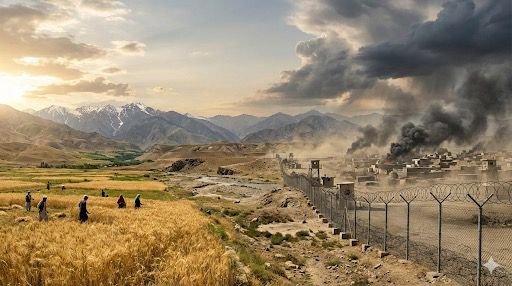
An Anchored Afghanistan Amidst Turbulent Regional Waters.
The latter half of 2025 was eventful for Afghanistan. The political consolidation of the Islamic Emirate of Afghanistan has been an ongoing trend since its assumption of power in August 2021. This trajectory has been examined in nearly every newsletter of The Afghan Eye. Political consolidation, by definition, implies greater certainty. Yet given this Islamic Emirate’s idiosyncrasies, certainty in form conceals volatility in substance. Specifically, this relates to the domains over which the shadow of unpredictable furmaans, or edicts, hangs. Most recently, this was seen in an abrupt internet and telecommunications blackout in October. Days later, the ban’s reversal was as puzzling and mired in vagueness as its original enforcement.
Yet Afghanistan remains standing, albeit confronted, by growing regional ripples. A World Bank report attested to its ongoing and optimistic economic recovery, but against the backdrop of ongoing humanitarian needs. Crucially, this recovery is because of, and despite, seemingly endless waves of returnees deported from Iran and Pakistan. Shifting dynamics have seen Kabul’s greater normalisation continue in the form of a long overdue rapprochement with Tajikistan, but balanced by murky attacks staged from Afghanistan against Dushanbe. Crucially, toward Afghanistan’s east, the outbreak of conflict in October, a hastily signed ceasefire and the breakdown of subsequent negotiations in Doha and Istanbul leave the door to conflict ajar.
Economic Outlook: Modest Growth Amid Structural Adjustment
In a year overshadowed by sluggish economic activity globally, the World Bank reported that the Afghan economy was projected to grow 4.3% in 2025. This marks the second consecutive year of growth, following 2.5% growth recorded in 2024. A certain economic resilience and ongoing post-war recovery are undeniable.
The report detailed strong agricultural performance, including a record wheat harvest despite adverse conditions of drought. Domestic tax revenues as a share of GDP continue to rise, whilst energy and mining contributed to overall economic output. The arrival of over two million returnees from Iran and Pakistan and their gradual reintegration into the domestic economy has buoyed services and small-scale industries. Inflation, due to the strong performance of an appreciating Afghani and stable food prices, is amongst the lowest in the region.
At the same time, the report highlighted the pitfalls associated with the waves of arrivals of the millions of Afghans being deported from Pakistan and Iran. GDP growth has been offset by an 8.6% population surge, yielding a 4% drop in GDP per capita. Other challenges remain. Banking remains crippled by regulatory uncertainty. Afghanistan remains in the grip of climate crises. Crucially, it remains dependent on foreign aid whilst uncertainty regarding a broader commercial regulatory framework and unpredictable restrictions on women’s work and education preclude meaningful foreign investment. Almost a quarter of young Afghans remain unemployed.
These challenges are hardly insurmountable, but require reforms and greater clarity regarding the country’s socio-political framework. Further reducing reliance on foreign aid requires increased private sector and foreign investment. These, in turn, rely heavily on politics. The report mentions ongoing restrictions on women’s work and education as hindrances to these. Equally as importantly, growth in foreign and domestic investment would be catalysed by greater opportunities for foreign markets and exports. The latter is particularly acute; crossings with Pakistan, after years of escalating tensions, have been closed.
Armed Confrontation with Pakistan
Tensions between Afghanistan and Pakistan have been constant over the years. This has been especially so since Imran Khan’s ouster in early 2022 and Pakistan’s descent into heavy-handed authoritarianism thereafter. The growing friction arising thereof has been covered prolifically by The Afghan Eye. This escalating trend exploded into outright conflict in the second half of 2025. Whilst tensions simmer below the surface of armed action, the possibility of another flareup remains high.
A broader pattern, resulting from and feeding these tensions, has been Pakistan’s consistent strikes on Afghan territory. This phase started in April 2022; Islamabad’s bombardment of Afghan territory primarily centred on the provinces of Kunar, Khost and Paktika, and alleged hideouts of the Tehreek-e-Taliban Pakistan (TTP) therein. At various junctures, Kabul has condemned these as violations of its sovereignty and, at others, retaliated with varying degrees of intensity.
This episode, however, was different. On 9th October, a loud blast was heard in Kabul in what was widely believed to be another Pakistani strike. The reported target of the strike was TTP chief Mufti Noor Wali Mehsud. Yet mere hours following the bombardment, Mehsud had sent a widely circulated WhatsApp voice message denying his death. Days later, Mehsud posted a video via official TTP handles showing he was alive in terrain appearing to be in Pakistan’s tribal areas. Pakistan had attempted to previously target other TTP commanders in its other bombardments in the southeast, but the bombardment of Kabul marked a watershed.
Crucially, due to the failure to kill Mehsud, Pakistan never claimed direct responsibility for the bombardment, even as Kabul quickly condemned it. On 11th October, meanwhile, Afghanistan retaliated in an operation targeting Pakistani outposts across the Durand Line. Fierce clashes broke out across the Line, and Pakistan went further on the escalatory ladder: it bombarded Kabul’s bustling Project Taimani commercial district, killing several civilians, destroying a local madrassa, and drawing outcry from across Afghan society.
Outrage was followed by a ceasefire signed in Doha on 19th October. The official Afghan statement confirmed that the agreement mandated good neighbourliness, abstinence from hostile actions and no support to be given to groups opposing Pakistan’s military junta government. The latter point was noteworthy insofar as it was obligatory solely on Kabul. Yet the ceasefire marked a relative defeat for Islamabad. A nuclear-armed Pakistan several times larger had routinely bullied its historically troubled Afghan neighbour. This time, Pakistan was forced to sit across the table and enshrine its commitment to treat Afghanistan as an equal: a disappointing climbdown after much chest thumping. Pakistani figures later began a concerted campaign chastising Qatar for supposedly taking Kabul’s side, whilst a reported leak revealed that Pakistani media too were instructed to adopt a hostile tone toward the Qatari media outlet Al Jazeera.
The ceasefire mandated follow-up talks in Turkiye, which had mediated the truce alongside Qatar. Those negotiations, however, broke down. As detailed in this exclusive by The Afghan Eye, Pakistan’s demands for Afghanistan to relocate within its territory more TTP fighters as well as declare written responsibility for all TTP attacks, including those plotted and executed outside Afghanistan, led to the breakdown of talks. Talks were even attempted in Saudi Arabia but according to Pakistan’s Deputy Prime Minister and Foreign Minister Ishaq Dar, these too unsurprisingly failed to yield any progress.
Trade, already battered by closures and clashes, was dealt a final knockout blow. On 12th November, Afghan Deputy Prime Minister Mullah Bradar Akhund issued a sternly worded directive to Afghan traders warning them to bypass Pakistan as a transit route within months, failing which, they would forfeit compensation. Subsequent Afghan statements reiterated trade would remain closed until firm assurances were given from Pakistan, which has resorted to closing crossings repeatedly, that it would henceforth desist from using trade as a tool of political pressure. Crucially, traders from Khyber Pashtunkhwa, decimated by abrupt closures, angrily lobbied a characteristically indifferent Islamabad for the opening of the Torkham crossing.
Rhetoric remained charged. On 11th December, a gathering of religious scholars convened in Kabul and issued a five point fatwa. The fatwa emphasised a few crucial points in a masterful balance. The Islamic Emirate of Afghanistan, it declared, was a religiously legitimate and lawful governing body. As a corollary, its defence against any aggressor was religiously binding on all Afghans. On the other hand, and more conciliatorily, it repeated that any military action outside Afghanistan, including Pakistan by implication, had not been sanctioned by the Amir and was therefore ‘unlawful’. The commitment that Afghan territory would not be used against other countries was repeated and underscored as religiously binding. Finally, it emphasised the need for Islamic countries to interact with one another on the basis of friendship and brotherhood.
In recent weeks, the temperature amongst some officials has become softer. Afghan Interior Minister Sirajuddin Haqqani reiterated that the ‘doors to dialogue’ remained open in recent remarks, in reference to Pakistan. Whilst the conciliatory tone is no doubt reassuring, much will depend not on Dar or his words, but on Pakistan’s worsening domestic disarray.
Domestic Disarray Across the Durand
Pakistan’s domestic disarray has compounded the crisis. Former Prime Minister Imran Khan remains imprisoned; ex DGISI Lt. Gen. Faiz Hameed was sentenced to 14 years in prison; and the political landscape is increasingly fractured. Khyber Pakhtunkhwa Chief Minister Sohail Afridi has emerged as a vocal critic of federal military policies. Criticism of the junta’s belligerence toward Afghanistan now cuts across the political spectrum, from provincial leadership to sidelined federal voices.
Dialogue requires a meaningful interlocutor, and therein lies the problem. With Pakistan’s militaristic Field Marshal Asim Munir at the helm, such a prospect looks flatly unlikely. The past few months saw Munir use military confrontation to catapult himself to unprecedented superiority in Pakistan. In the euphoria following Pakistan’s successful defence against India’s Operation Sindoor, Munir scrambled to have himself crowned as a Field Marshall: the second in Pakistan’s history. Munir rode the momentum further more recently to pass a controversial 27th Constitutional Amendment. The Amendment promoted him to the new position of Chief of the Defence Forces, or CDF, in addition to being granted lifelong immunity from prosecution.
Afghanistan is no exception to Munir’s characteristic insecurity cloaked in megalomaniac grandiosity, as evidenced by the 27th Amendment granting him lifelong immunity even as it conferred on him promotion to a newly created position. Munir’s vulnerability was attested to recently, when he addressed a gathering of religious scholars to burnish his religious credentials: under growing scrutiny amidst his close relationship with President Trump and related reports of Pakistan’s potential role in an international force for Gaza.
Moreover, Munir claimed Pakistan had ‘felt’ the help of God during its war with India in May, and that 70% of TTP fighters were what he derogatorily termed as ‘Afghanis’. Beggaring belief, he breathed new life into the very philosophy of George W. Bush that had in recent decades wrought so much destruction on the region. As Bush had once demanded others choose whether they ‘are with [Washington] or the terrorists,’ Munir demanded that Kabul choose between Pakistan or the TTP. Hardly promising for a bilateral thaw.
A Gathering Storm
Afghanistan has thus far weathered a gathering regional storm, but its fate in 2026 is undeniably tied to forces outside its territory as much as within. Pakistan’s military junta, desperate to resuscitate its lost regional relevance, has turned to its oldest trick: fomenting conflict with Afghanistan. This has ramifications not restricted merely to bilateral affairs. At international fora, Pakistan continues to bang the drum of Afghan-rooted terrorism and instability. It also threatens to jeopardise ties with other neighbours, namely Tajikistan. Kabul’s normalisation with Dushanbe, was followed by attacks on Tajikistan that, for the first time, were launched from Afghanistan. Kabul-affiliated media reported these having been planned outside Afghanistan, in implicit reference to Pakistan.
Beyond its immediate environs, however, turbulence is becoming a constant, and not an exception. In late June, Israel and Iran exchanged heavy blows in the new and unpredictable regional order still assuming shape since 7th October 2023. The same regional order has plunged Pakistan, meanwhile, to falling between the cracks of an unravelling alliance between Saudi Arabia and the UAE. Where and how Islamabad will navigate that remains to be seen, especially given a recent directive gagging its media from covering the fraying between Riyadh and Abu Dhabi. As Pakistan suffers from its balancing act, so too will Kabul have to map out the coming months.
As the year ends, the Durand Line remains heavily militarised and relations between Kabul and Islamabad remain at their lowest point in years. The conflict reflects not merely a bilateral dispute but a deeper structural rupture in regional security architecture.
Afghanistan enters 2026 shaped by a complex mix of pressures and possibilities. Its trajectory will depend not only on reforming internal governance and economic policy, but also on an unravelling regional environment.